Understanding Cost Variations Between National vs. International Agencies In Peak Climbing Services
Anyone planning a peak climbing expedition in Nepal quickly realizes a significant cost difference between national and international agencies. While both operators follow the same government guidelines and permit requirements, differences in packages, standard quality, staffing, and management affect the overall budget. Understanding these key variations allows climbers to choose an agency that matches their best interest, comfort level, expectation, adventure, and price.
In most cases, for the Lobuche Peak Climbing Budget, a local agency like Nepal Nomad charges around $2955 US dollars, whereas an international company will charge between $4500 and $7500. So, what is the reason behind the cost variation? Let's find out.
Subcontracting is one of the biggest reasons for the budget differences. Most international agencies do not own the logistics in Nepal plus they are not permitted to operate without partnering with local operators, so they hire a local partner to handle all the logistics, like permits, domestic flights, food and porters, which indirectly means you are paying for two companies. On the other hand, a national agency will book directly and obtain permission without any added commission, which automatically reduces the total cost by up to 30 per cent.
The salary of a lead Sherpa Guide also contributes hugely to the cost difference. The Global agency usually flies in a foreign UIAGM/IFMGA certified lead, and you are paying for their flights, salary based on western standard and professional insurance. In Nepal, experienced and UIAGM/IFMGA certified Sherpas are often the leaders. Even though their salary is huge, it is comparatively lower than that of Westerners. Also, the Sherpa stories you will hear on your expeditions are beyond price.
Insurance and liability are also important considerations. Many Western companies claim to carry professional liability insurance, meaning that if something goes wrong, their insurance may help you recover costs from the agency. In contrast, most local agencies only carry the mandatory government insurance for their staff, so in these cases you mainly depend on your own travel insurance, which becomes especially important.
The same goes for food, accommodation and comfort. An international company can easily provide imported good quality foods like energy bars, cheese, dry fruits, and meats. Their packages also include a five star hotel stay in Kathmandu and durable weather proof tents, comfortable chairs, and heated dining tents at the base camp.
Insurance and liability are other factors. Those Western companies claim to carry Professional Liability Insurance, so if anything goes wrong, your insurance will help you get your money back from the agency, but for a national (local) agency, they only suggest to carry the mandatory insurance required by the government for their staff, and you almost entirely rely on your travel insurance which is more than in need.
So, which one should you choose for your Lobuche Peak Climbing Cost 2026 plan? Actually, there is no right answer to this. You choose, as per your preference, how you want to experience peak climbing and how many facilities you want. A choice will always be yours.
Three Lobuche Peak Climbing Itinerary Options And Cost Variations
The Cost of Lobuche East Peak Climbing is affected not only by permits, seasons, agencies, and logistics, but also by the itinerary you choose. There are two distinct itineraries, one with EBC and Kala Patthar, and the other one is only focused on the technical part, from Lobuche town to the summit and back to Lobuche. From the legendary EBC and Kala Patthar adventure to a fast track ascent only expedition, both route offers a different rhythm of acclimatization days, safety protocols, mountain experiences, and, to top it all, the overall budget.
The most popular one is the route via Everest Base Camp. This itinerary includes both the EBC trek and the Kala Patthar trail. The extra few days spent trekking on these legendary routes not only deepens your authentic mountain experience but also enhances the summit success rate. More acclimatization days are equal to more time given to your body to adjust to the coldest and highest part of Earth. The itinerary involves more trekking days, 18 to be exact, additional guide and porter services, luxurious meals, and accommodation. The cost is higher and is estimated to be around $2955 per person.
The shortest or the fast track Lobuche East Peak climbing itinerary is made for only the professional climber. Since it is only for four days, your package only starts once you reach Lobuche and meet your Sherpa guide and crew members. There will be continuous trekking days with no break in between, and the pace will be demanding, hence only suitable for experienced climbers. You are entirely responsible for the rest of the journey to reach Lobuche town, return to Lukla or even Kathmandu. The price will be at its lowest, around $1500- 1700, but is only recommended for professional climbers who has knowledge of AMS and follows the rules of acclimatization on their own.
In Lobuche peak climbing, a longer itinerary means more acclimatization days, safety, a closer look at the Himalayan life, and a visit to iconic landmarks in between, but it also means you have to add extra cash to your Lobuche Peak Climbing Budget plan. At the end of the day, the right itinerary is not only about the decision regarding the added price but also about safety, AMS prevention, comfort, and more.
How Much Are Lobuche Peak Climbing Permit Fees and Domestic Flights Cost in 2026?
When planning for Lobuche Peak Climbing Cost 2026, your first account should be for the fixed expenditures, such as mandatory permit fees set by the Nepal government and airline consortia. These permits allow climbers legal access to the conservative areas and the peaks, and the fees generated help support financial development in the Everest region.
You require three distinct permits to climb Lobuche East. In 2026, the documents are increasingly digitized and QR code based and are strictly checked at various checkpoints in villages like Monjo, Namche, and Lobuche. The first permit you need is the NMA Climbing Permit. Since Lobuche East is a Group B trekking peak, NMA regulates the permit distribution and the cost management, which is heavily season based.
In spring (from March till May), the fee is estimated at USD $250 per person, in autumn (from September till November), the price is USD $125 per person, and in Winter/Summer (December/February and June/August), the cost is USD $70 per person. The price also varies between Nepalese citizens, SAARC Nationals and Foreigners. Much like the European Union, the SAARC union has agreements to promote regional travel in the most affordable way possible. So, the budget for SAARC members is $40 in Spring, $20 in autumn, and $10 in winter or summer.
Another permit is the Sagarmatha National park Entry Permit, as the peak sits within a UNESCO World Heritage site. The cost is approximately NPR 3, 000 approximately $23, plus 13 percent VAT (for SAARC members, NPR 1,500, $11.50 USD). The purpose of the permit is to cover trail maintenance and wildlife protection. Similarly, another compulsory document is a Khumbu Pasang Lhamu Municipality Permit. The price is NPR 3,000, USD $23 (for SAARC members, NPR 1,500, $11.50 USD), and the funds are utilized to develop the local Sherpa community for infrastructure development.
Besides the entry fees, another fixed cost in the Lobuche Peak Nepal Climbing Cost is the domestic flight, which is a flight from Kathmandu Airport to Tenzing-Hillary Airport, popularly known as the Lukla flight. Spring and autumn are the peak seasons for any mountain climb, so, to avoid the rush, during spring (from the third week of March to the third week of May) and Autumn (from the third week of September to the third week of November), the Civil Aviation Authority of Nepal (CAAN) redirects all the Lukla flights to depart from Ramechhap (Manthali). This means you now have to travel a four-hour drive from KTM to Ramechhap, and the round-trip price is estimated between $420 to $450. You are only allowed to carry 15 kg (33 lbs) per person and every kg over this is charged at around $1.50.
Another factor to consider while budgeting is the weather instability in the Khumbu region. If planes are grounded but choppers are still an option, a shared seat from Lukla to KTM or Ramechhap can cost between $400 to $600 USD. Always plan but have an option B when travelling to the Himalayas, as the weather is the ultimate gatekeeper.
Similarly, while not actually a fee per se, your agency, like Nepal Nomad, requires a fixed amount of deposit as a refundable Garbage deposit. The NMA requires the said deposit to ensure all the trash, including water bottles and food wrappers are brought back to Kathmandu. Waste does not decompose easily in the mountains; the plastics, wrappers, and food cans can stay there for decades. The villagers also do not have proper disposal facilities. The melting glaciers are the primary source of water in the Himalayan villages, and trash can Pollute both natural and water sources, so it is essential to manage your own waste in the high Altitude. If you failed to produce a Clearance Certificate from the Sagarmatha Pollution Control Committee (SPCC), you will not get your deposit back.
Experienced Sherpa Guide and Support Crew Price On Lobuche Peak Expedition
The success of an ascent of Lobuche Peak hugely relies on the human factor. This expedition requires a specialized team of highly trained professional staff and logistical support staff. From the initial planning phase to the final summit push, each team member plays a vital role in managing logistics, Himalayan operations, and safety in the harsh environment of the Khumbu region which is why their salary also plays a vital role in your Lobuche Peak Climbing Budget.
A certified trekking Guide and climbing Sherpa who possesses in-depth knowledge of the Lobuche climbing route, expertise in rope fixing, training, ice management, and Altitude risk management ensures climbers, especially new climbers, remain calm, confident, and composed. So, paying them properly is a fundamental part of responsible and ethical Lobuche East Peak Climbing.
The climbing Sherpa is a vital member of your team. They are responsible for managing the technical part of the ascent. They handle the rope fixing, monitor your heart rate and oxygen level, and make critical decisions of going forward or not, depending on the weather. As of 2026, their daily wage ranges from $30 to $50 USD. While the climbing Sherpa focuses on the technical aspects, a trekking guide manages the days before the summit. They are responsible for lodge bookings, permit checks, making proper acclimatization plans, and the most fun part of the journey a cultural storytelling. On the summit day, the trekking guides stay behind to manage communications and potential rescues. Their daily wages are estimated between $25 to $35 USD.
Likewise, porters are the ones doing the heavy lifting. They handle all your expedition gear, allowing you to trek freely. They carry your boots, crampons, sleeping bag, and so on. Legally, your porter is only allowed to lift to 20kg to 25kg (44 to 55 lbs), so always make sure they are comfortable and within the legal limit. Their per day fees are around $20 to $25 USD.
Lobuche climbing requires a stay in tented camps in the base camp, so you need a dedicated kitchen staff to maintain your calorie intake and overall body strength. The team usually consists of a head cook and an assistant who will prepare high calorie health meals like soups, eggs, and pasta. Their combined wages equal roughly $40 to $50 USD.
In Nepal, a responsible tourism act requires trekkers and mountaineers via the agency to be responsible for the staff's safety. In this case, Nepal Nomad provides medical and accidental insurance, technical gear, and cold appropriate clothes and footwear to every staff member. So, what about tipping? Well, tipping is an integral part of the Himalayan economy. It is not technically included in your Lobuche Peak Nepal Climbing Cost package price as tipping is not mandatory but highly expected, and you should budget it as a separate cash expense. You can plan to tip around 15% to 20% of the total staff salary, so for your 18 days itinerary, the recommended tip for your climbing Sherpa is $150 to $250, the trekking guide is $100 to $150, the porter is $50 to $80, and the Kitchen Crew is $50 to $70.
Mountaineering Gear And Equipment Budget What It Takes To Summit Lobuche East?
The mountaineering gear and equipment budget should be carefully planned in your Lobuche Peak Nepal Climbing Cost. As Lobuche is a technical climb, the gears are divided into two phases: trekking gear for the trekking parts and technical mountaineering gear for the summit push. The price can vary depending on a few factors, such as buying or renting the tools and a few clothing items, whether you hire a private guide or join a group through an agency.
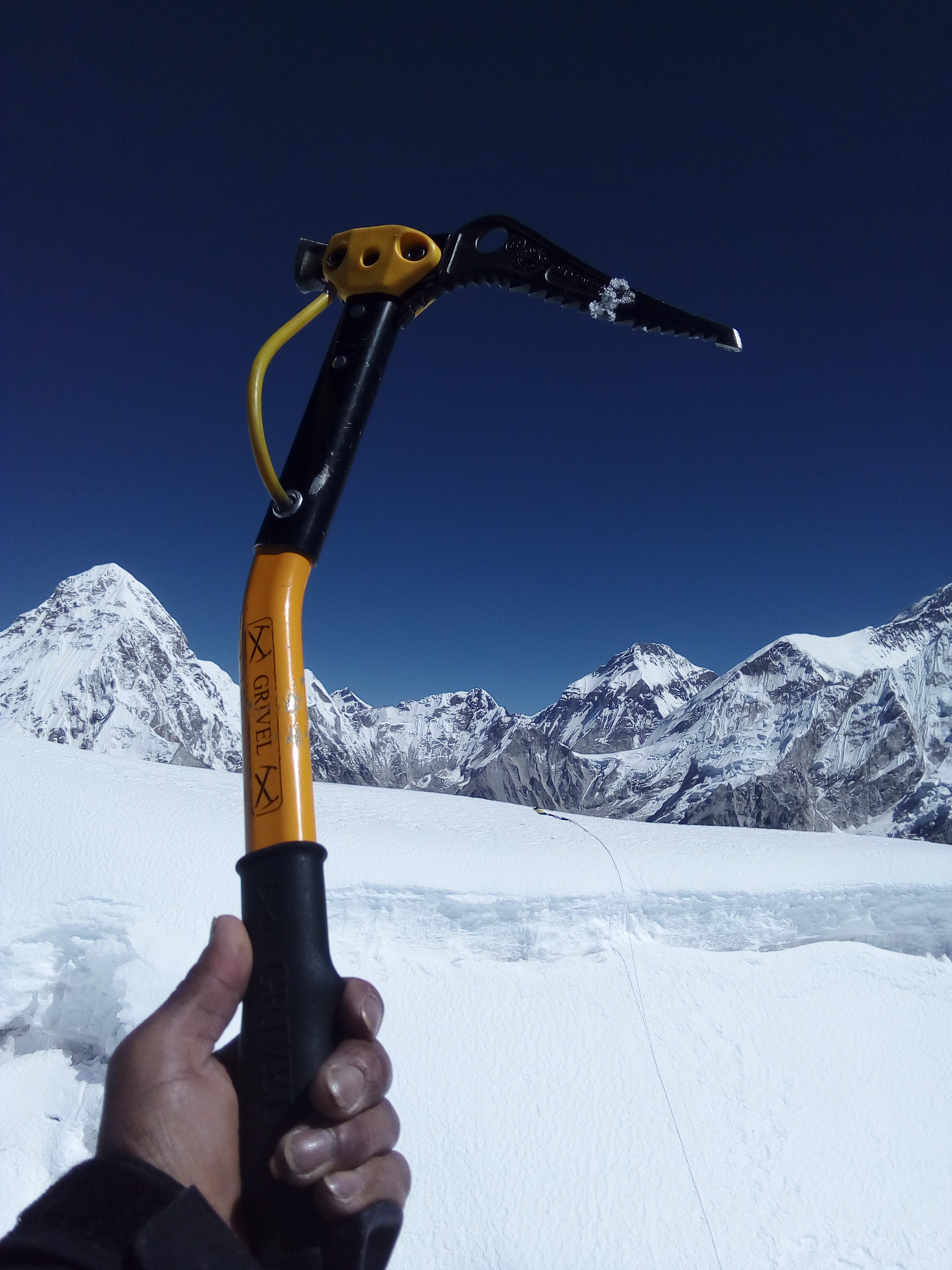
The essential technical climbing gears are an ice axe used like a walking stick, a pair of insulated mountaineering boots, 12 point steel crampons fitted to your boots to help you for the technical climb, a climbing harness, and an ascender, which are important for the fixed rope sections. a descender used for descending the steep sections, carabiners and a climbing helmet.
As Mountain weather is very unpredictable, you need to be fully equipped for all possible rapid climate change. In the Himalayas, people generally follow three rule clothing style to stay warm. The base layers are two sets of merino wool, the mid-layers are one heavy fleece jacket, and one pair of fleece or softshell pants and outer shells are hardshell, waterproof jackets and pants. Also, a heavyweight insulated down jacket with a hood is a must for the summit day.
Likewise, head and hand protection gear are also equally important. You will need a three layer gloves, a warm beanie, a neck gaiter, glacier glasses and ski goggles. You will also require a -20°C (0°F) sleeping bag, a sleeping pad, a pee bottle, a waterproof duffle bag and a good quality water bottle.
The price varies depending on whether you decide to buy or rent these gears. You can easily buy and rent all the necessary items from Kathmandu, Thamel or Namche Bazaar.
Gears | Estimated Buying Price | Estimated Renting Price |
Mountaineering Boots | $400 to $600 | $5 to $10 per day |
Crampons and Ice Axe | $300 to $500 | $15 to $25 |
Sleeping Bag | $400 to $600 | $3 to $5 per day |
Insulated Down Jacket | $150 to $300 | $5 to $10 per day |
Base and Mid Layers | $80 to $200 | $3 to $5 per day |
Harness and Helmet | $100 to $200 | $5 to $10 per day |
Ascender and Jumars | $300 to $500 | $15 to $25 |
PRO TIP: If you hire a reputed agency like Nepal Nomad, a technical gear pack which consists of crampons, ice axe, harness, and jumar is part of the package and can be available for a flat rental fee of around $150 to $200 USD.
Seasonal Cost Variations For Lobuche Peak Climbing Expedition
One essential thing a climber needs to understand when planning for Lobuche Peak Climbing Cost 2026 is that the overall price is not fixed; it heavily fluctuates depending on the time of year or season you choose to climb.
The spring season from March to May is considered the Everest Season and is one of the expensive seasons among the four main seasons. Packages are at a premium, and as the demand for lead guides and porters is at its peak, their daily rates will also increase. Domestic flights are fully booked months in advance. If you miss your flight, getting another ticket will be almost impossible, and a last minute helicopter seat can cost you between $500 to $800. Similarly, all the tea houses will be packed, and you may end up paying more for added facilities like better rooms.
The autumn season, from September to November, is also an ideal season to climb due to stable weather and clear views, generally preferred by mountain photographers. The costs are equally expensive like spring if not more as Louche Peak is a technical climb. All the teahouses will be jam packed and finding a guide will also be a challenge.
Winter, from December to February, is much cheaper compared to the two but comes with a high risk. Accommodation in the Khumbu region often offers rooms at a heavy discount. You also have to pay extra for gear, as the standard gear cannot be used because of the harsh weather. Flights from Kathmandu or to Kathmandu can get cancelled frequently due to fog, which means spending more on a lodge or even a helicopter evacuation if necessary.
Summer and Monsoon are the cheapest but has a highest risk. Lukla airport is often closed due to heavy rain, leeches, and landslides, making the trek part difficult, and the risk of avalanches in the mountains makes the climb part almost impossible. It is highly recommended to avoid these two seasons as the risk of climbing is way higher than any other factors; be it cost friendly or less crowded. In Nepal, mountaineering permit costs also vary by season. In spring, the permit cost is $250, in autumn, $125, and in winter and summer, the price is $70.
Group vs. Solo Climbing Cost Comparison, Which One Is Cheaper?
Deciding between joining a Group or a Solo / Private Expedition for Lobuche East Peak is an important factor in determining your Lobuche Peak Nepal Climbing Cost. Group climbing is generally the affordable option, and the primary reason is the ability to split the fixed costs.
A climbing guide charges up to $30 to $50 per day, plus a summit bonus and a tip, so when in a group, the price can be distributed. Usually, one guide takes care of four climbers, so you only have to pay 25 per cent of the guide's daily wage. But if you are travelling solo, you need to have a mandatory guide and porters, and you are responsible for paying their salary, food, and insurance for the entire duration.
During your stay at the base camp, the price between the kitchen tent, toilet tent, dining tent, and kitchen staff salary is divided among the group, but if you are solo, you are automatically paying for the entire camp setup.
Similarly, in Lobuche Peak, fixed ropes are essential for the headwall. A large group often coordinates to fix ropes together, but only one person may have to take help from the guide or may be asked to pay a rope fee, which can be up to $200, to another team that put the lines in place.
There is also a single supplement fee, which applies even if you are in a group but want your own space; you have to pay a few extras, as group prices are based on twin-sharing accommodation. In Kathmandu hotels, you might have to pay an extra 40 to 100 dollars, at tea houses, an extra 10 to 20 dollars per night and at base camp an extra 100 to 200 dollars.
Which one is better? Well, a group expedition can save up to 50 per cent compared to a private trip, you can enjoy meeting fellow climbers, more people means more guides and helpers in case of an emergency. Similarly, a solo trip means walking in your own space, adding or subtracting acclimatization days as per your need, extra time for photos, your own personal bed and room. Each option has a fair share of advantages; it is up to you which one matches your idea of a climbing trip.
Hidden Expenses On Your Lobuche Peak Expedition
When budgeting for the Lobuche peak climbing cost, you pay a total package price to the agency you hired, but that is not the total cost. You always have to consider the many hidden expenses that can add $500 to $1500 to your final bill.
In the Trekking and climbing industry, one is expected to pay a handsome tip. The tip does not have a fixed rate, but one is expected to pay an extra $150 to $300 to their climbing guide after a successful and safe summit. Similarly, at the end of the trip, a collective tip or bonus is given to all the staff, which is usually 10 to 15 per cent of the total trip cost, for about $100 to $200 USD.
Agencies like Nepal Nomad provide full board (three meals and a bed), but you are responsible for paying for the added facilities. Your teahouses will charge you ($2 to $5) per hour for every electronic device you charge, like phones, cameras and power banks. In the Khumbu region, you have to buy Everest Link Wi-Fi cards, which can cost $10 to $ 25 for 10GB to 20GB. Hot showers are considered premium luxury, and high-altitude lodges will charge $5 to $10 per hot shower.
Specialized technical climb insurance is another hidden cost. A standard travel cost does not cover mountaineering at 6,000m, so you need a specific policy in your insurance clause that includes technical mountaineering and search and rescue (helicopter evacuation). Also, keep extra money to cover delayed flights or helicopter seats as the weather in the mountains are highly unpredictable, and you may need to choose alternative options.
An occasional Khumbu treat can also add a few extra on your budget plan. Unique Himalayan cuisine, a heartfelt souvenir, occasional bakery treat at high altitude is a few examples. For your 18 days Lobuche itinerary, you will need to carefully choose your visa duration. The 30 day visa is the most common choice, which costs around $50 USD. If your expedition is delayed for any reason and you exceed your visa, you have to pay $45 for the minimum extension of 15 days, and after the first 15 days, it costs $3 per day. If you stay without extending your visa, you will be fined $5 per day at the airport upon departure. In Nepal, a tourist cannot stay for more than 150 days in a single calendar year. The visa factor is also necessary to consider when planning Lobuche Peak Climbing Cost 2026.
Wrapping Up Your Lobuche Peak Climbing Cost Plan
Summiting Lobuche Peak is one of the most rewarding mountaineering experiences, especially for those who are stepping into technical climbing. Planning a successful expedition is not just about physical preparation but also about budgeting wisely. Understanding all the costs involved helps to focus entirely on the climb without expensive surprises along the route.
From logistics, permit fees and domestic flights to food, lodging, guide services and gear, each expense plays an important role in your total investment. Additional considerations like seasonal variations, national vs international agency, solo vs group climb, and hidden charges can also impact your Lobuche Peak Climbing Budget.
By carefully planning and comparing all these factors, you can craft a realistic budget plan which also helps you to maximize safety, comfort and climb success rate without financial stress.