Bumthang Tangbi FestivalBumthang Tangbi Festival

Experience the Bumthang Tangbi Mani Festival and Discover Bhutan Beyond the Ordinary

  • Duration11 Days
  • DestinationBhutan
  • Difficulty Level Moderate
  • Max Altitude Taktsang (Tiger's Nest) Monastery – 3,120 m (10,236 ft)
  • Group Size 2
  • Starts Kathmandu
  • Ends Kathmandu
  • Activity Festival: Bumthang Tangbi Mani Festival
  • Best Season Visit: September (Festival Season)

The true spirit of Bhutan is often found far beyond its famous landmarks, in quiet valleys where centuries old traditions continue to shape everyday life. The 11 Day Bumthang Tangbi Mani Festival Tour is designed for anyone chasing an authentic Bhutan experience beyond the well-trodden Paro Thimphu Punakha loop, reaching instead into Bumthang, the country's spiritual heartland, for a centuries-old celebration that has never been reshaped for outside visitors. At the center of the journey is the Thangbi Mani Festival, held each autumn at Thangbi Lhakhang, a 15th century temple tucked into the Choekhor Valley, which is one of the most authentic, lesser known Bhutanese festivals still largely untouched by international tourism. Where a first time visitor to Bhutan might reasonably start with Paro or Thimphu, this itinerary is built for the traveler already drawn to something deeper: a hidden Himalayan gem rather than another entry on a well worn bucket list.

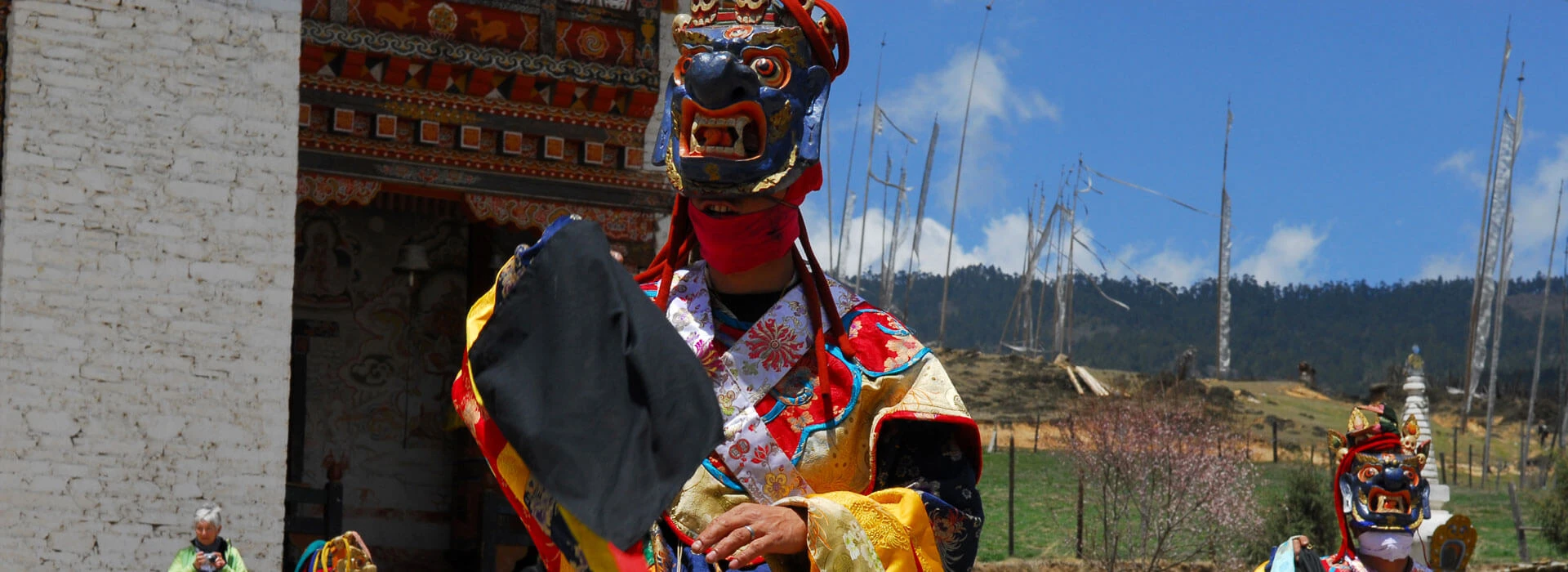
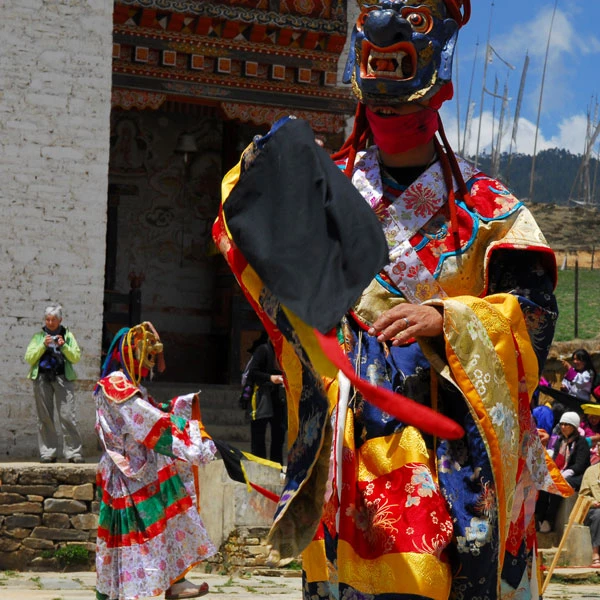
Unlike the country's larger, more photographed Tshechus, Thangbi Mani unfolds on a genuinely local scale: masked Cham dancers move through the temple grounds, performing rituals of protection and purification, while the festival's signature moment, the Mewang fire-blessing ceremony, sees villagers leap through open flame to cleanse the year's misfortune, a tradition that has continued largely unchanged since the temple's founding. For travelers drawn to off the beaten path Himalayan festivals rather than the more familiar festival circuit, this is about as close as Bhutan gets to an unfiltered, community first celebration, organized by and for the villages of Bumthang rather than staged with visiting crowds in mind.

The 11 day route leading there is deliberately unhurried, built for slow travel rather than a rushed highlight reel. From arrival in Paro, the itinerary moves through Thimphu's living blend of tradition and modern governance; the riverside grandeur of Punakha Dzong; and the winding mountain road east toward Bumthang, passing through Trongsa, home to one of Bhutan's most commanding dzongs, along the way. After the festival and a full day exploring Bumthang's ancient temples and valley villages, the return journey threads back through Wangdue and the glacial stillness of Gangtey and Phobjikha Valley before closing in Paro with the pilgrimage hike to Taktshang, the Tiger's Nest Monastery. Each leg adds its own layer to the trip, so that by the time the itinerary loops back to Paro, Bumthang's festival feels less like an isolated detour and more like the emotional center the rest of the journey was quietly building toward.

This is a Bhutan cultural festival tour built for those who want more than a checklist of famous sights: hidden Himalayan temples rarely visited by foreign guests, immersive village encounters, and a festival that exists for the community that keeps it alive, not for the tourists who happen to witness it. Whether the draw is authentic Buddhist festivals, remote monastery visits, or simply a slower, more transformative way to experience the Himalayas, the Bumthang Tangbi Mani Festival Tour offers a version of Bhutan that most visitors never get to see, one measured less in landmarks checked off than in moments that feel genuinely, unmistakably loca.

  • Experience the Tangbi Mani Festival, an intimate celebration of Bhutan's living Buddhist traditions in the spiritual heartland of Bumthang.
  • Explore off the beaten track Bhutan in the spiritual heartland of Bumthang Valley.
  • Witness sacred Cham dances, traditional rituals and centuries-old Buddhist ceremonies.
  • Visit the historic Tangbi Monastery and centre of the festival celebrations.
  • Explore the cultural sites of Bhutan’s beautiful capital city of Thimphu.
  • Explore the architectural beauty of Punakha Dzong, one of the most iconic fortresses of Bhutan.
  • Enjoy the beautiful mountain scenery of Trongsa, Wangdue and Gangtey.
  • Experience the tranquillity of Gangtey and Phobjikha Valley, home to traditional villages and unspoiled nature.
  • Trek to the famous Taktsang (Tiger's Nest) Monastery, the most sacred pilgrimage site in Bhutan.
  • Discover the spiritual heritage of Bhutan through ancient monasteries, sacred temples and hidden valleys.
  • Enjoy scenic drives through forests, mountain passes and picturesque landscapes of the Himalayas.
  • Experience Bhutan's culture through its local traditions, warm hospitality and authentic village life.
  • Discover more cultural knowledge and memorable moments with an expert local guide.

Why Experience the Tangbi Mani Festival?

Bhutan has no shortage of festivals, but few offer what Tangbi Mani does: a genuinely local celebration, still shaped entirely by the villages that keep it alive, in a valley many consider the country's spiritual center. Here's what sets the experience apart.

An Authentic Celebration

Tangbi Mani ranks among Bhutan's most authentic and lesser known cultural festivals, celebrated on a scale that couldn't be further from the country's larger, more heavily attended Tshechus. Villagers, not visiting tour groups, shape the atmosphere, creating a noticeably thinner crowd and an unhurried pace. Because outside influence has never really reshaped how the festival is run, traditions here have been preserved largely unchanged for centuries, from the order of the rituals to the way the community itself organizes the days around it making this an off the beaten path journey for travelers who want a Bhutan experience genuinely removed from the country's most visited destinations, rather than a variation on the same festival circuit most visitors already know.

Sacred Rituals at One of Bumthang's Oldest Monasteries

At the center of the festival are sacred Cham dances and Buddhist rituals performed by monks, staged at Tangbi Monastery, one of Bumthang's oldest and most revered religious sites. Attending offers a rare, close-up window into Bhutanese Buddhist belief and practice in a valley widely regarded as the country's spiritual heartland; a reputation Bumthang has earned through its unusually dense concentration of ancient temples, sacred sites, and stories tied to Guru Rinpoche and other founding figures of Bhutanese Buddhism. Each dance and ritual performed carries its meaning, passed down through generations of monks rather than adapted or shortened for an outside audience. For anyone curious about the customs and community life behind Bhutan's religious calendar, few settings offer a clearer or more unfiltered view than Tangbi Mani, where ritual and daily village life sit side by side rather than being separated for an audience.

Experience a genuine connection with Bhutanese communities.

Unlike festivals built around a steady stream of foreign visitors, Tangbi Mani is celebrated alongside local families and villagers who have gathered here for generations, creating genuine cultural interaction rather than a staged photo opportunity. Vibrant costumes, sacred ceremony, and unguarded, authentic moments unfold throughout the day: children weaving between adults, elders watching from familiar spots, and neighbors catching up between rituals all approached with the same respect a guest would bring into someone else's community celebration rather than a tourist attraction built to be photographed.

A Complete Autumn Journey Through Bhutan's Spiritual Heartland

Beyond the festival itself, the journey pairs Tangbi Mani with some of Bhutan's most iconic stops like Punakha Dzong, the glacial stillness of Gangtey Valley, the commanding fortress of Trongsa Dzong, and the pilgrimage hike to Tiger's Nest Monastery. Timed to Bhutan's autumn season, the trip moves through valleys at their most lush, under clear skies and ideal sightseeing weather, with none of the haze or rain that can settle over the country during the summer months. The result is slow, immersive travel that balances spirituality, nature, history, and meaningful cultural encounters into a single, unhurried itinerary, rather than a rushed circuit of famous sights ticked off one after another. For visitors who've already seen the highlight reel of Bhutan or simply want their first trip to go deeper than the standard route, this itinerary is built around exactly that kind of depth.

The Tangbi Mani Festival: History, Rituals & Sacred Meaning

More than a colorful cultural celebration, the Tangbi Mani Festival is a living expression of Bhutan's deep-rooted Buddhist faith and centuries-old traditions. Held annually at the historic Tangbi Monastery in Bumthang, the festival brings together monks, villagers, and pilgrims to honor sacred teachings through ritual ceremonies, symbolic mask dances, and community gatherings. Understanding its history and spiritual significance allows visitors to appreciate the festival as more than a spectacle, it is a meaningful celebration of Bhutan's enduring cultural and religious heritage.

The Founding of Tangbi Monastery

Tangbi Lhakhang, the temple at the center of the festival, dates back to the 15th century, founded by the 4th Shamar Rinpoche, one of the two highest-ranking lamas of the Kagyu school, who traveled to Bumthang from Tibet. Set in the wide, fertile Choekhor Valley overlooking the river, the temple has served as the community's spiritual anchor for well over five hundred years, its sanctuaries holding statues and paintings that have watched over the same annual rituals for generations. The temple's upper sanctuary is known for remarkable paintings depicting Zangtho Pelri, Guru Rinpoche's celestial paradise, alongside the paradise of Amitabha, the Buddha of Infinite Light; imagery that has framed the festival's rituals since long before any outside visitor ever attended one.

Purification, Protection, and the Purpose of the Festival

At its core, Tangbi Mani exists to protect the community rather than to entertain visitors. The rituals performed are believed to purify misfortune accumulated over the previous year, invoke blessings for health and a bountiful harvest, and reaffirm the valley's spiritual protection for the year ahead. Every element of the festival, from the dances to the fire ceremony, serves that same underlying purpose, which is part of why the atmosphere feels less like a performance and more like a community renewing something it depends on. Villagers plan their year around it in much the same way families elsewhere plan around a harvest festival or a religious holiday central to their calendar.

The Mewang Fire Blessing Ceremony

The festival's most striking moment is Mewang, the fire blessing ceremony held on open ground. Lay monks perform purification rituals before villagers take turns leaping through open flame, a practice believed to burn away the past year's misfortune and negative influences. It's a dramatic, communal ritual rather than a spectator event where locals participate directly rather than simply watching, and the ceremony's intensity is part of what makes Tangbi Mani distinct even among Bhutan's many fire and purification rites. Visitors typically observe from the edges of the ground, close enough to feel the heat and hear the crowd's reaction as each person clears the flames.

Sacred Cham Dances and Their Meaning

Masked Cham dances unfold across the festival grounds, performed by monks portraying deities, protective spirits, and mythical figures drawn from Buddhist teaching. Each dance tells its story through movement rather than words, echoing the same symbolic tradition found at larger Tshechus elsewhere in the country; the swirl of costume, the rhythm of drums and horns, and the deep chanting that accompanies each sequence all carry specific religious meaning rather than existing purely for spectacle. A recurring figure worth watching for is the Atsara, a clown-like character who moves between comic relief and ritual role, blurring the line between the sacred proceedings and the community's more lighthearted moments and often drawing the loudest laughter from the crowd between more solemn performances.

How Tangbi Mani Differs from Paro and Thimphu Tshechus

Where Paro's and Thimphu's festivals draw large crowds, including many international visitors, Tangbi Mani remains organized by and for the villages of the Choekhor Valley, largely as it has been for centuries. The scale is smaller, the setting is a single village temple rather than a major dzong, and the fire-blessing ceremony gives it a ritual centerpiece the bigger Tshechus don't share. For anyone who has already experienced Bhutan's larger festivals, Tangbi Mani offers a genuinely different register: an intimate, community-driven, and largely unshaped by tourism, where the sense of being a guest at someone else's celebration, rather than an audience member at a show, is impossible to miss.

A Journey Through Bhutan's Spiritual Heartland: Paro to Bumthang

Before setting out for Bhutan's spiritual heartland, here's how your eleven day adventure unfolds, from the welcoming valleys of Paro to the timeless traditions of Tangbi Mani and the iconic cliffs of Tiger's Nest.

The Tangbi Mani Festival sits at the emotional centre of this trip, but the road there is very much a part of the story. The route begins in Paro, Bhutan's spiritual gateway, where the valley is framed by the country's finest traditional architecture, and then moves into Thimphu, where centuries of tradition sit comfortably alongside the modern capital, with monasteries and government buildings sharing the same skyline. From there, the journey continues east to Punakha, whose riverside dzong anchors Bhutan's royal and religious history at the confluence of the Pho Chhu and Mo Chhu rivers, its fertile valley a striking contrast to the higher, cooler terrain left behind.

From Punakha, the journey climbs towards Trongsa, home to one of Bhutan's most commanding fortress-dzongs and a natural waypoint on the long drive east before descending into Bumthang itself, the wide, temple studded valley widely regarded as the country's spiritual heartland and the setting for the Tangbi Mani festival. After the festival and a full day exploring Bumthang's ancient sites and valley villages, the route loops back west through Wangdue towards Gangtey and Phobjikha Valley, a glacial bowl known for its stillness and traditional rural life, before returning to Paro for the pilgrimage hike to Taktshang, the Tiger's Nest Monastery.

Each stop adds its own layer to the trip: living tradition in Thimphu, royal legacy in Punakha, imposing history in Trongsa, sacred festival and ancient temples in Bumthang, rural quiet in Phobjikha, and a cliffside pilgrimage to close it all in Paro. Together, these destinations turn the Tangbi Mani Festival from a remarkable event witnessed in isolation into a fuller journey through Bhutan's history, spirituality, and everyday life. The detailed 11 day itinerary below walks through each of these stops in full, including distances, altitudes, and the local insight that shapes every day of the trip.

How Nepal Nomad Trekking Plans Your Tangbi Mani Journey

An 11 day trip built around a remote village festival takes more coordination than a standard Bhutan itinerary. Between an autumn festival date set by the lunar calendar, permits for travel far beyond Paro and Thimphu, and a route that spans nearly the length of the country, this is a trip where planning genuinely shapes the experience.

Planning Around Bhutan's Autumn Festival Calendar

Tangbi Mani follows the Bhutanese lunar calendar rather than a fixed autumn date, typically falling in September, with exact dates confirmed only months in advance. Because the festival is smaller and far less publicized internationally than Paro or Thimphu's Tshechus, accurate scheduling depends on close contact with local sources in Bumthang rather than a widely published calendar. Nepal Nomad Trekking builds the itinerary around the confirmed dates as they're released, ensuring the trip lands on the actual festival days rather than an estimate.

Visas, Route Permits & Sustainable Development Fees Managed for You

This itinerary travels well beyond the Paro Thimphu corridor, through Punakha, Trongsa, Bumthang, Wangdue, and Gangtey, which means route permits are required for nearly the entire trip rather than a single side excursion. In addition to handling the regular e-Visa and Sustainable Development Fee, Nepal Nomad Trekking takes care of getting these permits from Bhutanese authorities ahead of time, as delays in permits can have a bigger impact on a trip that covers multiple regions compared to a shorter, single valley trip.

Licensed Bhutanese Guides Who Bring Tangbi Mani to Life

A knowledgeable guide is more important at Tangbi Mani, a village festival with little English-language information available on-site, than at Bhutan's larger, better-documented Tshechus. Licensed, English speaking guides explain the meaning behind the Mewang fire ceremony and each Cham dance; help navigate festival etiquette in a setting with far fewer international visitors; and provide the historical context-Tangbi Monastery's founding and Bumthang's role in Bhutanese Buddhism that turns the day into more than an unfamiliar spectacle.

Comfortable Travel Across an 11 Day Himalayan Route

Reaching Bumthang and looping back involves considerably more driving than a standard Paro Thimphu-Punakha trip, so comfort over distance becomes a real planning priority. A private vehicle, experienced driver, and carefully chosen overnight stops in Punakha, Trongsa, Bumthang, and Gangtey keep daily drive times manageable, with built-in stops at places like Trongsa Dzong rather than treating long transit days as time to endure simply.

A Well Paced Itinerary Designed Around the Festival

As with any festival timed trip, Tangbi Mani sits at the center of the itinerary rather than being squeezed between other stops. Punakha, Trongsa, Gangtey, and Tiger's Nest are sequenced to build toward and away from the festival naturally, minimizing backtracking across an already long route and giving each destination enough time to register rather than blur into the next.

Local Insight Beyond the Guidebook

Much of what makes a village festival like Tangbi Mani rewarding isn't written down anywhere: which part of the grounds offers the clearest view of the Mewang ceremony, how the community expects visitors to behave in a much more intimate setting than Paro or Thimphu, or which nearby temple is worth the extra half hour. Licensed guides supply that local insight throughout the trip, not just on festival day, turning a well-planned route into a genuinely well-understood one.

How Much Does the 11 Day Tangbi Mani Festival Tour Cost?

An 11 day trip built around a remote Bumthang festival carries a higher price tag than Bhutan's shorter, more central itineraries, largely because of distance and duration rather than festival demand. Unlike Paro Tshechu, which drives prices up through sheer seasonal crowding, Tangbi Mani's cost comes mainly from covering more ground, more nights, and more route permits across a longer stretch of the country.

Average Cost of the 11 Day Tangbi Mani Festival Tour

This itinerary typically runs between US$3,400 and US$5,100 per person, depending on hotel category, group size, and season. Group departures land towards the lower end of that range, since fixed costs like the vehicle and guide are shared across more travellers, while private, custom paced trips push towards the higher end. As with Bhutan's other packages, the price is bundled: accommodation, meals, guide, private transport, permits, and government fees rolled into one per-person rate rather than billed separately.

Why an 11 Day Bumthang Itinerary Costs More Than a Standard Loop

The biggest driver of cost here is simply distance. Reaching Bumthang and looping back through Trongsa, Wangdue, and Gangtey adds several extra driving days compared to a standard Paro Thimphu Punakha trip, and each additional night carries its own Sustainable Development Fee regardless of how remote the destination. Route permits for travel beyond the Paro Thimphu corridor add further coordination, and hotel options thin out considerably once the route moves past Punakha, meaning fewer competing properties and less pricing flexibility in towns like Trongsa and Bumthang. None of this reflects festival-season demand the way Paro Tshechu pricing does, as Tangbi Mani remains a small, lightly attended local festival, but the sheer length and remoteness of the route make this one of the more expensive itineraries in Bhutan's cultural festival lineup.

Estimated Cost Breakdown

Cost Component

Approximate Price (per person)

Sustainable Development Fee (SDF)

US$100 per night × 10 nights = US$1,000

Bhutan Visa Fee

US$40 (one-time)

Kathmandu – Paro – Kathmandu Flight

US$450 – US$550 (round trip)

Land Package (guide, driver, hotel, meals, route permits)

US$190 – US$320 per night × 10 nights = US$1,900 – US$3,200

Estimated Total

US$3,400 – US$5,100

Spring's Paro Tshechu Festival Tour vs. Autumn's Bumthang Tangbi Festival Tour

Bhutan doesn't have one festival season; it has two distinct ones, and each shapes an entirely different kind of trip. The Paro Tshechu Festival Tour, held each spring, is Bhutan at its most vibrant and accessible: a major Tshechu at one of the country's grandest dzongs, drawing large crowds of Bhutanese pilgrims and international visitors alike. The Bumthang Tangbi Festival Tour, held each autumn, is Bhutan at its most unguarded: a small village festival in the country's spiritual heartland, run by and for the local community, with international visitors still very much the exception rather than the norm.

The difference in scale changes everything about the experience. The Paro Tshechu unfolds across the courtyard of Rinpung Dzong, building toward the pre-dawn unfurling of the sacred Thongdrel on its final morning, a dramatic, communal spectacle shared with thousands. Tangbi Mani, by contrast, centers on the Mewang fire blessing ceremony at a single village temple, where villagers leap through open flame in a ritual that has barely changed in five centuries. One is Bhutan's festival calendar at its biggest; the other is Bhutan's festival calendar at its most local.

Practically speaking, the two trips also differ in length, cost, and effort. The Paro Tshechu tour runs 5 to 8 days within Bhutan's more accessible western loop, keeping costs and travel time lower. The Bumthang tour stretches to 11 days and reaches deep into central Bhutan, adding driving time, route permits, and cost, the trade-off for reaching a festival most visitors never even hear about.


Paro Tshechu Festival Tour (Spring)

Bumthang Tangbi Festival Tour (Autumn)

Season

March to April

September (autumn)

Duration

8 days

11 days

Scale

One of Bhutan's largest, most-attended Tshechus

A small, local village festival

Setting

Rinpung Dzong, a major fortress-monastery

Tangbi Lhakhang, a single village temple

Atmosphere

Vibrant, crowded, festive energy

Intimate, community-driven, quiet

Signature Moment

Pre-dawn Thongdrel unfurling

Mewang fire blessing ceremony

Approx. Cost

US$1,600 to US$4,200

US$3,400 to US$5,100

Best For

First-time visitors, photographers, festival energy

Repeat visitors, slow travelers, authenticity seekers

If this is a first trip to Bhutan, or the goal is festival energy, iconic architecture, and a shorter, more accessible itinerary, the Paro Tshechu Festival Tour is the stronger fit. If Bhutan is already familiar or the priority is authenticity over scale and slow, immersive travel over a packed highlight reel, the Bumthang Tangbi Festival Tour offers a version of the country far fewer visitors ever see. Neither is a lesser choice; they're simply two different answers to the same question: what does an unforgettable Bhutan festival actually look like?
Itinerary

Expand AllClose All

The journey begins with a memorable trans Himalayan flight into Paro Valley, one of the most spectacular commercial arrivals in the world. As the aircraft banks between lush forested ridges, passengers are treated to panoramic views of towering snow-capped peaks before touchdown. After clearing immigration, travellers are greeted by their local guiding team and begin a scenic drive through the pure Paro and Wang Chhu river valleys to Thimphu, Bhutan's captivating capital.

The evening unfolds as we immerse ourselves in the slower pace of life in the kingdom's urban heart. Getting to know the kingdom's urban heart's slower pace of life. Thimphu is not like any other modern capital on earth, retaining its old world integrity with visitors walking past uniquely painted buildings and local artisan markets without the hustle of typical metropolitan life. At the end of the day, indulge in a relaxing dinner of fresh, organic local ingredients and the perfect introduction to deep cultural immersion.

Today's Highlights

  • Flying into Paro International Airport and enjoying the thrill and views.

  • A scenic introductory drive along the winding Pa Chhu and Wang Chhu rivers.

  • Strolling in the streets of Thimphu. The only national capital in the world with zero automated traffic lights.

Authentic Bhutan

In the Traffic Light Rejection in the late 1990s, authorities in Thimphu installed a single traffic light to bring the city into the modern age. It was too cold, mechanical and impersonal for the locals compared to their traditional ways. It was soon dismantled, and even today, traffic at the main intersection is expertly handled by a single, white-gloved traffic policeman whose fluid, dance-like hand gestures have become a cherished national emblem of human-centric urban living.

  • Max. Altitude:2,334 m (7,657 ft)
  • Accommodation:Hotel in Thimphu
  • Time:1.5 hours
  • Meals:Lunch, Dinner
  • Walking Distance:Approximately 55 km (34 mi)

Thimphu spends today revealing why it remains one of the only capital cities in the world where ancient ritual and modern governance share the same skyline. The morning starts with a short drive up to the towering Buddha Dordenma statue, its bronze form rising 169 feet above the valley floor, before continuing to the National Memorial Chorten, where local devotees keep up a steady, clockwise circuit of prayer wheels and quiet mantras that has continued daily since the monument was built.

The afternoon turns to how Bhutan actively preserves its living traditions rather than simply displaying them: a visit to the National Institute for Zorig Chusum, where students train in the country's thirteen traditional arts, followed by the Pure Bhutan living museum. As the light softens toward evening, Tashichho Dzong closes out the day, a fortress of timber framing built entirely without a single iron nail, serving today as both the seat of civil government and the summer residence of the central monastic body.

Today's Highlights

  • Standing beneath the 169 foot bronze Buddha Dordenma for sweeping valley views.

  • Joining local devotees on their clockwise circuit around the National Memorial Chorten.

  • Touring Tashichho Dzong, the nail-free fortress at the heart of Bhutanese governance.

  • Watching young artisans train in the traditional arts at the Institute of Zorig Chusum.

Authentic Bhutan Fact: The Thirteen Sacred Arts:

Zorig Chusum, the thirteen traditional arts and crafts formalized in the 17th century, anchor much of Bhutan's cultural identity. These crafts were never treated as decorative trades: a master woodcarver or painter works without a blueprint or a personal signature, channeling the effort into the object itself so the finished piece functions as a source of spiritual merit for anyone who encounters it.

  • Max. Altitude:2,334 m (7,657 ft)
  • Accommodation:Hotel in Thimphu
  • Time:45 minutes to 1 hour cumulatively
  • Meals:Breakfast, Lunch, Dinner
  • Walking Distance:Inner city driving (approx. 20–30 km total)

The capital falls behind this morning as the road climbs through blue pine and hemlock forest toward Dochula Pass at 3,100 meters. On a clear day, the pass opens onto a 360 degree view of the snow-capped Eastern Himalayas, framed by the 108 Druk Wangyal Chortens lining the hillside, a quietly striking place to pause among fluttering prayer flags before the descent begins.

From the cool heights of Dochula, the road drops more than 1,900 vertical meters into the warm, subtropical basin of the Punakha Valley, trading pine forest for cactus and terraced rice paddies within a single afternoon. The valley's centerpiece, Punakha Dzong, sits at the exact confluence of the Pho Chhu (Male) and Mo Chhu (Female) rivers, its whitewashed walls and towering shrines reached by a traditional wooden cantilever bridge and still holding centuries of the kingdom's founding history.

Today's Highlights

  • Crossing the 3,100-meter Dochula Pass and its 108 memorial chortens.

  • Taking in panoramic Eastern Himalayan views on a clear morning.

  • Exploring Punakha Dzong, the historic “Palace of Great Happiness” at the river junction.

  • Walking the traditional wooden cantilever bridge over the Mo Chhu.

Authentic Bhutan Fact: The Confluence of Rivers

Punakha Dzong sits precisely where the turbulent Pho Chhu and the calmer Mo Chhu meet. In Bhutanese spiritual tradition, rivers have unique energies, and where they meet is considered a place that naturally eliminates rid of negative forces, a belief that helps explain the valley's surprisingly calm atmosphere, despite the fortress's stormy past.

  • Max. Altitude:1,200 m (3,937 ft)
  • Accommodation:Hotel in Punakha
  • Time:3 hours
  • Meals:Breakfast, Lunch, Dinner
  • Walking Distance:Approximately 75 km (46 mi)

Today's long cross country drive marks the real shift into central Bhutan, tracing river gorges, high ridges, and remote hamlets along the way. The route crosses Pele La Pass (3,300 m), traditionally regarded as the boundary between western and central Bhutan, before dropping into the Mangde Chhu valley for a view of Trongsa Dzong anchored against the hillside.

After a brief stop in Trongsa, the road climbs once more over Yotong La Pass (3,400 m) before descending into the broad, pine covered valleys of Bumthang: four connected valleys widely regarded as Bhutan's spiritual cradle. Arriving in Jakar by late afternoon brings an immediate shift in atmosphere: old wooden farmhouses are set among wide buckwheat fields and a stillness that marks the area as one of the country's most timeless corners.

Today's Highlights

  • Taking the long, scenic mountain drive across central Bhutan's geographic spine.

  • Crossing historic Pele La Pass, marked by prayer flags and high grazing pastures.

  • Viewing Trongsa Dzong, built into a dramatic cliffside setting.

  • Arriving in the wide, serene valleys of Bumthang, the country's historic spiritual center.

Authentic Bhutan Fact: The Gatekeeper of the East

Trongsa Dzong once controlled all overland travel between western and eastern Bhutan; the only footpath connecting the two halves of the country ran straight through its central courtyard, and the fortress's gates could be closed at will. For centuries, crossing Bhutan required the explicit permission of the Penlop (governor) of Trongsa, a designation that cemented the valley's outsized historical power.

  • Max. Altitude:2,650 m (8,694 ft)
  • Accommodation:Hotel/Boutique Lodge in Jakar (Bumthang)
  • Time:7 to 8 hours
  • Meals:Breakfast, Lunch, Dinner
  • Walking Distance:Approximately 212 km (131 mi)

Today is the cultural centerpiece of the entire journey: the Tangbi Mani Festival at Tangbi Lhakhang, founded in 1470 by the 4th Shamar Rinpoche, one of the two highest ranking lamas of the Karma Kagyu school. The temple's history is intertwined with the legendary Nyingma treasure-revealer Pema Lingpa, native to this very valley, whose forged iron chain still hangs at the entrance today. Far smaller and more intimate than Bhutan's larger urban Tshechus, Tangbi Mani draws farmers and families from the surrounding valleys, dressed in their finest handwoven ghos and kiras, for one of central Bhutan's most authentic community driven religious gatherings.

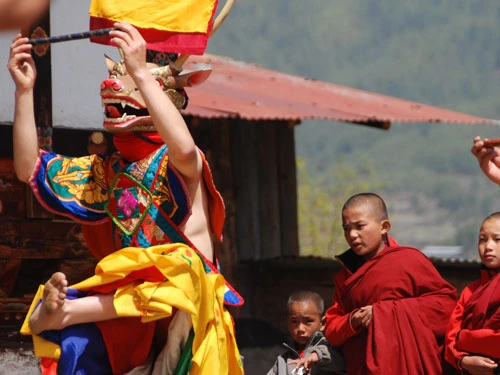
The day unfolds through sacred Cham mask dances performed by monks in elaborate silk brocade, each dance a physical reenactment of Buddhist teaching meant to purify the ground and bless everyone watching. The energy builds toward the Mewang fire blessing ceremony, when a large archway of dry straw is set alight, and villagers leap through the flames to burn away the past year's misfortune and invite positive fortune for the one ahead.

Today's Highlights

  • Attending the authentic Tangbi Mani Festival inside a historic 15th-century temple courtyard.

  • Watching sacred Cham mask dances performed by monks in vivid silk brocade costumes.

  • Experiencing the high-energy Mewang fire-blessing ceremony alongside local families.

  • Taking in the colorful, handwoven traditional dress of Bumthang's rural communities.

Authentic Bhutan Fact: The Secret Architecture of Cham Dances

The mask dances performed at the festival are not staged theater but active ritual: every foot placement, hand gesture, and turn traces a precise geometric pattern onto the courtyard floor. The monks undergo weeks of fasting, prayer, and meditation before performing, acting as conduits for protective deities rather than simply reenacting a story for an audience.

  • Max. Altitude:2,650 m (8,694 ft)
  • Accommodation:Hotel/Boutique Lodge in Jakar (Bumthang)
  • Time:30 minutes total
  • Meals:Breakfast, Lunch, Dinner
  • Walking Distance:15 km (9.3 mi) round trip transfer to the temple

Today moves deeper into Bumthang's valleys, home to some of the oldest sacred sites in the Himalayas. The morning connects Kurjey Lhakhang, where Guru Rinpoche is said to have left a body imprint in solid rock, with Jambay Lhakhang, a 7th-century temple built as part of an ancient network anchoring a mythical demoness across the region, via a quiet walk through pine forests and open fields between the two.

The afternoon leads to Mebartsho, the “Burning Lake” set in a forested river gorge, where the treasure revealer Pema Lingpa is said to have plunged into the water holding a lit butter lamp and resurfaced with hidden spiritual treasures, the flame still burning. The day winds down at a local Bumthang farmhouse, sampling regional specialties like buckwheat cakes, Swiss-style cheese, and Red Panda beer, Central Bhutan's distinct culinary signature.

Today's Highlights

  • Visiting Kurjey Lhakhang to see the rock cave bearing Guru Rinpoche's body imprint.

  • Exploring the 7th century foundations of Jambay Lhakhang, one of Bhutan's oldest shrines.

  • Walking down into the gorge at Mebartsho, the Burning Lake, past rows of small clay offerings.

  • Sampling local buckwheat cakes and cheese at a traditional Bumthang farmhouse.

Authentic Bhutan Fact: The Demoness Subdued

Jambay Lhakhang is said to have been built by the Tibetan Emperor Songtsen Gampo in the 7th century as part of a plan to pin down a giant demoness said to lie across the Himalayan landscape, blocking the spread of Buddhist teachings. Emperor Songtsen Gampo in the 7th century as part of a plan to pin down a giant demoness said to lie across the Himalayan landscape, blocking the spread of Buddhist teachings. Legend holds that 108 temples were built simultaneously across her body's key points; Jambay Lhakhang was placed precisely at her left knee, anchoring the valley's spiritual energy ever since.

  • Max. Altitude:2,650 m (8,694 ft)
  • Accommodation:Hotel/Boutique Lodge in Jakar (Bumthang)
  • Time:45 minutes cumulative
  • Meals:Breakfast, Lunch, Dinner
  • Walking Distance:Short valley drives (approx. 15–20 km total)

The westward return begins today, retracing the mountain highway back across central Bhutan's high passes. After climbing out of the Bumthang valleys and crossing Yotong La, the route pauses in Trongsa for a closer look at Trongsa Dzong's maze of stone courtyards, covered corridors, and watchtowers overlooking the gorge below.

Past Trongsa, the road climbs Pele La Pass a final time before dropping into the warmer Wangdue Phodrang valley, where terraced hillsides and wide riverbanks open up after the high mountain scenery. Arriving by late afternoon, the newly restored Wangdue Phodrang Dzong catches the last light on its ridge above the valley.

Today's Highlights

  • Taking a scenic return drive back through central Bhutan's high alpine passes.

  • Touring the interior courtyards and watchtowers of historic Trongsa Dzong.

  • Crossing the Yotong La and Pele La passes, with views of grazing yaks in the high pastures.

  • Arriving in Wangdue Phodrang to see the restored ridge-top fortress at sunset.

Authentic Bhutan Fact: The Architectural Rebirth

The original 17th century Wangdue Phodrang Dzong was destroyed by fire in 2012. Rather than rebuild with concrete and steel, Bhutan launched a decade-long restoration using only traditional methods such as hand tools, mud mortar, and interlocking joinery, turning the loss into a masterclass that preserved centuries-old construction techniques for a new generation of craftsmen.

  • Max. Altitude:1,300 m (4,265 ft)
  • Accommodation:Hotel in Wangdue Phodrang
  • Time:6 to 7 hours
  • Meals:Breakfast, Lunch, Dinner
  • Walking Distance:Approximately 195 km (121 mi)

A short but striking drive today climbs through bamboo groves and oak forest into the high altitude glacial bowl of Phobjikha, also known as Gangtey. Unlike the narrow river gorges found across most of the country, this wide, U-shaped wetlands valley opens onto broad horizons and a distinctly peaceful, open landscape.

The afternoon centers on Gangtey Goemba, a 17th century monastery perched on a ridge overlooking the valley floor, followed by the popular Gangtey Nature Trail, an enjoyable two hour walk past farmhouses and blue pine, with views over the protected wetlands that serve as the wintering ground for Bhutan's rare, migratory black-necked cranes each year between November and March.

Today's Highlights

  • Driving into Phobjikha Valley, a rare U- shaped glacial wetland landscape.

  • Touring historic Gangtey Goemba, overlooking the valley floor.

  • Hiking the scenic Gangtey Nature Trail past pine forest and rural farmhouses.

  • Visiting the Black Necked Crane Information Center to learn about local conservation work.

Authentic Bhutan Fact: The Sacred Circumambulation of Cranes

Each winter, hundreds of black-necked cranes migrate from the Tibetan Plateau to Phobjikha Valley. On arrival, the cranes reliably circle Gangtey Goemba three times in flight before landing in the wetlands below, a pattern local communities regard as a spiritual gesture of respect (kora) toward the monastery and one reason the cranes are considered protectors of the valley.

  • Max. Altitude:2,900 m (9,514 ft)
  • Accommodation:Hotel/Eco Lodge in Phobjikha Valley
  • Time:2.5 hours
  • Meals:Breakfast, Lunch, Dinner
  • Walking Distance:Approximately 65 km (40 mi)

The longest driving day of the return loop heads west from Phobjikha back toward Paro, descending through the sub tropical valleys of Wangdue and Punakha before climbing one final time over Dochula Pass. The drive doubles as a compact tour of Bhutan's shifting ecosystems: alpine wetlands, warm river basins, and high pine forests, all within a single afternoon.

Skirting the edge of Thimphu, the route joins the smooth Paro highway alongside the Pa Chhu river, arriving back in the valley by late afternoon. The evening is left deliberately unhurried, time to rest and prepare for the following morning's hike to Taktshang, the Tiger's Nest Monastery, and the trip's final major milestone.

Today's Highlights

  • Taking a cross country return drive through Bhutan's changing ecological zones.

  • Crossing Dochula Pass one last time for a final look at the mountain peaks.

  • Following the scenic Pa Chhu river valley back into Paro.

  • Settling into Paro for a restful evening ahead of the Tiger's Nest hike.

Authentic Bhutan Fact: The Living Highway Markers

Along the national highway, boulders and cliff faces are frequently painted with vivid images of Buddhist deities and protective symbols. These aren't roadside decorations: local lamas create them as active spiritual markers, meant to bless the road, guard against rockfall, and remind drivers to keep a calm, mindful state of mind on the winding mountain curves.

  • Max. Altitude:2,280 m (7,480 ft)
  • Accommodation:Hotel in Paro
  • Time:5.5 to 6 hours
  • Meals:Breakfast, Lunch, Dinner
  • Walking Distance:Approximately 190 km (118 mi) total

The pilgrimage hike to Taktshang Monastery marks the trip's defining moment. Starting early to beat the midday sun, the trail climbs steadily through a pine forest draped in Spanish moss and strung with prayer flags, reaching a cliffside viewpoint after roughly two hours, the first full view across the gorge of the 17th century monastery clinging to a sheer 900 meter granite face.

A stone bridge over the sacred waterfall gorge leads into the heart of the complex, where candle-lit shrines hold the story of Guru Rinpoche, said to have flown to this cliff on the back of a tigress to meditate and anchor Buddhism in the country. The descent is gentler, and the evening closes with a celebratory traditional dinner in Paro, a fitting space to reflect on the journey before departure.

Today's Highlights

  • Hiking through mossy pine forest to the cliffside heights of Paro Taktsang.

  • Taking in the viewpoint across the gorge at the Tiger's Nest's gravity defying architecture.

  • Exploring the candle lit inner shrines and meditation caves of the monastery.

  • Sharing a final, celebratory traditional dinner with the guiding team.

Authentic Bhutan Fact: The Miraculous Construction

According to local legend, when Paro Taktsang was built in 1692, workers faced the near impossible task of hauling timber and stone up a sheer cliff face. Tradition holds that dakinis, female spiritual deities, carried the heavy materials up the mountain using the strength of their hair, a story still told today as a symbol of faith overcoming physical limitations.

  • Max. Altitude:3,120 m (10,236 ft) at the monastery
  • Accommodation:Hotel in Paro
  • Time:20 minute transfer to the trailhead
  • Meals:Breakfast, Lunch, Dinner
  • Walking Distance:4 km (2.5 mi) uphill one-way (8 km / 5 mi round trip)

The journey closes this morning with a final breakfast before a short, unhurried transfer to Paro International Airport. Guide and driver handle luggage and terminal formalities directly, keeping the last stretch of the trip as smooth as the eleven days that preceded it.

As the Drukair or Bhutan Airlines flight lifts out of the narrow valley, a window seat on the right side offers one last look at the green terraced fields and white dzong walls below before the peaks of the Eastern Himalayas come into view, a quiet close to eleven days built around ancient festivals, high mountain passes, and a genuinely mindful way of life.

Today's Highlights

  • Enjoying a final, relaxed breakfast before departure.

  • Taking a smooth, guided transfer to the airport terminal.

  • Catching a last aerial view of the Himalayas on the return flight.

Authentic Bhutan Fact: A Respectful Farewell

It's customary to tip guides and drivers at the end of a Bhutan trip, typically presented in a small envelope with both hands as a gesture of appreciation and respect. While the practice itself is a relatively modern addition to Bhutan's tourism industry rather than an ancient tradition, the two-handed, unhurried way it's offered reflects a much older Bhutanese instinct: that how something is given matters as much as the gift itself.

  • Max. Altitude:2,280 m (7,480 ft)
  • Accommodation:None
  • Time:15 to 20 minutes
  • Meals:Breakfast
  • Walking Distance:Approximately 5 km (3 mi)
What's Included
  • Airport transfers in Bhutan (arrival and departure)
  • Private tourist vehicle for all transfers, sightseeing, and excursions
  • Licensed English-speaking Bhutanese tour guide
  • Accommodation in comfortable 3 star hotels (upgrades available upon request)
  • Daily breakfast, lunch, and dinner as specified in the itinerary
  • Bhutan visa processing assistance
  • Sustainable Development Fee (SDF) and all applicable Bhutan government taxes
  • Entry fees to monuments, museums, monasteries, and sightseeing attractions mentioned in the itinerary
  • Tangbi Mani Festival entrance and cultural experiences
  • Excursion to Taktsang (Tiger's Nest) Monastery
  • Bottled drinking water during road journeys
  • Government royalty and service charges
  • Comprehensive pre-departure travel information and tour support
What's not Included
  • International airfare to and from Bhutan
  • Nepal visa (if applicable)
  • Premium hotel upgrades and single room supplements
  • Travel insurance (medical, evacuation, trip cancellation, and baggage coverage)
  • Personal expenses, including laundry, telephone calls, Wi-Fi charges, and beverages
  • Alcoholic drinks and additional snacks
  • Tips and gratuities for guides, drivers, and hotel staff
  • Camera or video fees where applicable
  • Expenses arising from flight delays, natural disasters, political unrest, road closures, or other unforeseen circumstances beyond the tour operator's control
  • Any services, meals, or activities not specifically mentioned under Cost Includes
Good to Know

What to Pack for the Bumthang Tangbi Mani Festival Tour

Packing wisely ensures a comfortable and enjoyable journey through Bhutan's diverse landscapes, cultural sites, and festival celebrations. Here's a list of essential items to bring for the Bumthang Tangbi Mani Festival Tour.

Layered Clothing

  1. Pack lightweight clothing for warm daytime temperatures and warm layers for cool mornings and evenings, especially in Bumthang and Gangtey.

  2. Bring a fleece or insulated jacket, as temperatures can drop at higher elevations.

Comfortable Walking Shoes

  1. Wear sturdy, comfortable walking or trekking shoes suitable for sightseeing, village walks, and the hike to Tiger's Nest Monastery.

  2. Pack extra pairs of moisture-wicking socks for added comfort.

Weather Protection

  1. Carry a waterproof jacket or lightweight raincoat, as mountain weather can change quickly.

  2. A compact umbrella can also be useful during occasional showers.

Sun Protection

Bring sunglasses, sunscreen, a wide brimmed hat or cap, and lip balm to protect against the strong mountain sun.

Daypack

A small backpack is ideal for carrying water, snacks, a camera, and other daily essentials during sightseeing and hikes.

Modest Clothing for Monastery Visits

Pack clothing that covers shoulders and knees when visiting temples and monasteries, out of respect for local customs and religious traditions.

Personal Essentials

Carry personal medications, a basic first-aid kit, toiletries, hand sanitizer, and a reusable water bottle.

Electronics

Pack a camera or smartphone, charger, power bank, and a universal travel adapter for charging devices.

Travel Documents

Keep passport, Bhutan visa, travel insurance documents, flight tickets, and emergency contact information in a secure, waterproof pouch.

Optional Items

  1. Binoculars for birdwatching and mountain views.

  2. Trekking poles for extra support during the Tiger's Nest hike.

  3. A notebook or journal for recording memorable experiences.

  4. A reusable shopping bag for local purchases.

Festival Etiquette Tip

Since the Tangbi Mani Festival is an active religious celebration rather than a staged performance, dress respectfully, avoid obstructing ceremonies while taking photographs, and follow the guide's instructions when visiting sacred areas.

Quick Reference Packing Checklist

Category

Items

Layered Clothing

Lightweight daytime clothing, fleece or insulated jacket

Footwear

Sturdy walking/trekking shoes, moisture-wicking socks

Weather Protection

Waterproof jacket or raincoat, compact umbrella

Sun Protection

Sunglasses, sunscreen, wide-brimmed hat, lip balm

Daypack

Small backpack for water, snacks, camera, daily essentials

Monastery Attire

Clothing covering shoulders and knees

Personal Essentials

Medications, first aid kit, toiletries, hand sanitizer, reusable water bottle

Electronics

Camera/smartphone, charger, power bank, universal adapter

Travel Documents

Passport, visa, insurance, flight tickets, emergency contacts (waterproof pouch)

Optional Items

Binoculars, trekking poles, notebook, reusable shopping bag

Bhutan Visa & Entry Requirements

Unlike most countries, Bhutan's visa system ties entry directly to a booked, prepaid trip instead of issuing visas freely to any applicant. Understanding how the process works before departure makes for a far smoother start to the Bumthang Tangbi Mani Festival Tour.

Who Needs a Bhutan Visa?

Almost every foreign passport holder needs a pre-approved visa to enter Bhutan. The only exceptions are citizens of India, Bangladesh, and the Maldives, who require a free entry permit instead of a full visa. For everyone else, a visa clearance letter must be issued before departure: Bhutan does not offer visas on arrival.

How the Bhutan Visa Application Process Works

Visa applications are processed either through Bhutan's official tourism portal or, more commonly, by a licensed Bhutanese tour operator acting as sponsor. Booking through a licensed operator matters here: entry is only granted alongside a confirmed, prepaid itinerary, so the application can't be submitted independent of a booked trip. Required documents are minimal: a scanned passport copy, a passport style photograph where applicable, and basic personal and travel details with the operator handling submission and follow-up directly.

Visa processing time and the visa clearance letter are important aspects to consider.

Processing typically takes about five to seven working days once documents and payment are submitted, though it can run faster outside peak travel periods. The result is a visa clearance letter, which functions as proof of approved entry and must be presented when checking in for the flight to Bhutan. Airlines will not board passengers without it, so it's worth confirming receipt well ahead of departure.

Entry Points: Arriving by Air or Land

Most visitors enter through Paro International Airport, Bhutan's only international airport, served by Drukair and Bhutan Airlines. Overland entry is also possible through a small number of approved border crossings from India, including Phuntsholing, Gelephu, and Samdrup Jongkhar, though these routes are used far less often by international tour groups than the Paro flight.

Before You Travel: Passport Validity and Staying Informed

A passport valid for at least six months beyond the travel dates is required for entry, and it's worth checking the validity well before booking flights rather than close to departure. Because Bhutan's immigration and entry regulations can be updated occasionally, it's always worth confirming the latest requirements shortly before travel, ideally through the licensed tour operator arranging the trip.

Language and Communication: Useful words and phrases for Travelers

Dzongkha is the official national language of Bhutan, but visitors on the Bumthang Tangbi Mani Festival Tour usually communicate easily. Bhutan Standard Time (BTT) is observed in Bhutan all year round, with a time zone of UTC+6. Bhutan does not observe daylight saving time. In addition to Dzongkha, there are many regional dialects spoken in different parts of the country, reflecting the cultural diversity of valleys such as Paro, Bumthang, and Phobjikha.

Here are few commonly used words and phrases during the festivals:

  • Kuzuzangpo La – Hello

  • Kadinchey La – Thank you

  • Inn – Yes

  • Metoe – No

  • Chhu – Water

  • Lhakhang – Temple

  • Dzong – Fortress-monastery

  • Tshechu – Religious festival

  • Lama – Buddhist teacher

  • Cham – Sacred masked dance

  • Tashi Delek – Best wishes

  • Legso – Okay

All year round Bhutan is in Bhutan Standard Time (BTT), which is UTC+6. Bhutan does not have daylight saving time. It is worth checking the time difference from home before you travel to plan connections with international flights via Kathmandu and to coordinate communication with family or colleagues while you are traveling.

You’ll find mobile networks and local SIM cards in most towns en route, but coverage will be patchy in more remote mountain areas, particularly around high passes and lonely valleys such as Phobjikha. Hotels usually have Wi Fi, but outside the larger towns, speeds and reliability can vary widely, so it’s worth setting expectations accordingly rather than counting on a quick, constant connection throughout. For those who plan to explore on their own between guided stops, it’s a simple, worthwhile precaution to download offline maps and a translation app before departure.

Responsible Tourism in Bhutan During Bumthang Tangbi Mani Festival

Bhutan has built its tourism model on a simple idea: growth means little if it is at the expense of the environment, culture, or communities it relies on. Every guest of the Bumthang Tangbi Mani Festival Tour plays a small part in that balance, and a few thoughtful habits along the way go a long way toward keeping Bhutan's landscapes and traditions intact for the generations who'll inherit them next.

Respect Local Culture Dress modestly, adhere to monastery etiquette, and observe religious ceremonies and local customs with genuine attention rather than passing curiosity, and your visit will be respectful rather than intrusive, especially at a village-scale festival like Tangbi Mani, where the line between guest and spectator matters more than it might elsewhere. But in such an intimate space, small gestures like removing shoes when appropriate or lowering a camera while praying have real meaning.

Support Local Communities. Purchasing handicrafts from local artisans, dining in family run establishments instead of only hotel restaurants, and traveling with licensed Bhutanese operators means that tourism revenue stays in the same communities that make the trip possible in the first place. The impact of spending is even greater on a route like this, where a lot of the itinerary is not in major cities but rather in smaller towns.

Reduce Plastic Waste: It costs nothing to carry a reusable water bottle and a shopping bag on the road for eleven days, and it goes a long way in reducing the amount of single-use plastic in a country that is actively working to limit its environmental footprint.

Leave No Trace: In a country where tourism has been purposely kept light, it matters more to dispose of waste responsibly and help keep trails, villages, and sacred sites litter-free. The same restraint that makes Bhutan's landscapes feel untouched depends on every visitor doing their part to keep them that way. It’s true on much of the Tiger’s Nest trail as it is around the quieter trails around the temples of Bumthang.

Protect Nature and Wildlife: Avoid wandering off established trails in the more remote parts of the itinerary, do not disturb wildlife, and leave plants and their natural habitats undisturbed to help preserve fragile environments such as the wetlands of the Phobjikha Valley, where species and ecosystems do not recover easily from casual damage. The forested paths around Bumthang’s ancient temples are treated the same way, with the undergrowth and trees as much a part of the setting as the buildings themselves.

Conserve Resources: Be mindful of water and electricity usage, especially during the more remote parts of the itinerary, such as in the more remote parts of the itinerary days, such as Bumthang and Gangtey. Local communities rely on the same resources as travelers, and infrastructure is less developed than in Paro or Thimphu. Small habits like taking shorter showers or turning off lights when you leave a room add up over the course of eleven days in a group.

Travel Responsibly: Adhere to the guide’s directions, respect restricted zones without exception, and consider each stop as a component of a shared, natural, and environmental, litter-free experience. Travel Responsibly: Adhere to the guide’s directions; respect restricted zones without exception; and consider each stop as a component of a shared, natural, and environmental litter-free experience rather than a personal photo opportunity. All of the above can be woven into one simple standard for the entire trip.

Experience the Bumthang Tangbi Mani Festival and Discover Bhutan Beyond the Ordinary FAQs

  • Bumthang Tangbi Mani Festival is one of the most ancient and authentic religious festivals in Bhutan. Celebrated annually at Tangbi Lhakhang in Bumthang Valley, it features sacred Cham dances, traditional rituals, and community festivities that embody Bhutan’s vibrant Buddhist legacy.

  • The festival is usually held in September, but the actual dates are determined every year according to the Bhutanese lunar calendar. It is suggested to check the confirmed festival schedule before planning the trip.

  • Difficulty: The tour is generally rated easy to moderate. It’s a mix of cultural sightseeing, scenic drives, village walks, and a hike to Tiger’s Nest Monastery. Most travelers require a moderate degree of fitness.

  • The highlight of the trip is Tiger’s Nest (Taktsang) Monastery, at around 3,120 meters (10,236 feet) above sea level.

  • The risk of altitude sickness is generally very low, as the itinerary includes gradual altitude changes and moderate altitude stays. Good hydration, walking at a comfortable pace, and time to acclimatize all contribute to a comfortable journey.

  • Accommodation is generally in comfortable 3 star hotels with 4 and 5 star upgrades available on request. All accommodations are chosen for comfort, cleanliness, and easy access to major attractions.

  • Most tour packages include breakfast, lunch, and dinner each day. Meals offer a mix of Bhutanese cuisine and international dishes to cater to a range of tastes.

  • Yes. Vegetarian meals are available throughout Bhutan, and most hotels can cater to common dietary requirements given sufficient notice.

  • Travel is by private, comfortable tourist vehicle with an experienced local driver. Depending on the size of the group, the size of the vehicle is chosen to ensure a comfortable journey.

  • It is strongly recommend that you take out travel insurance. A good policy will include medical treatment, emergency evacuation, trip cancellation, baggage protection, and other unexpected travel disruptions.

  • You’ll need layers, comfortable walking shoes, a warm jacket, rain gear, sunscreen, sunglasses, a reusable water bottle, any personal medications, travel documents, and a camera.

  • Photography is generally allowed in the open areas of the festival but may be restricted inside monasteries and at certain religious ceremonies. Always seek permission first and follow local guidelines when photographing monks or local residents.

  • Yes. This itinerary is suitable for families, couples, solo travelers, and first-time visitors looking for a balanced mix of cultural experiences, scenic landscapes, and light hiking.

  • Best Time: September for the Tangbi Mani Festival. During this time, Bhutan has good weather, clear mountain views, and lively cultural festivals.

  • For a more authentic cultural experience, the Bumthang Tangbi Mani Festival provides a more intimate, community-based experience in the spiritual heart of Bhutan. In comparison, the Paro Tshechu Festival is bigger, more popular, and more suited to those seeking the festival experience of Bhutan’s most famous festival.