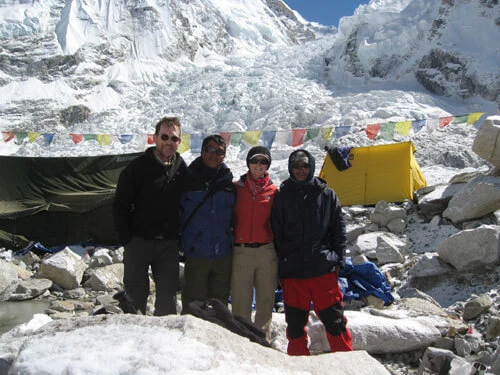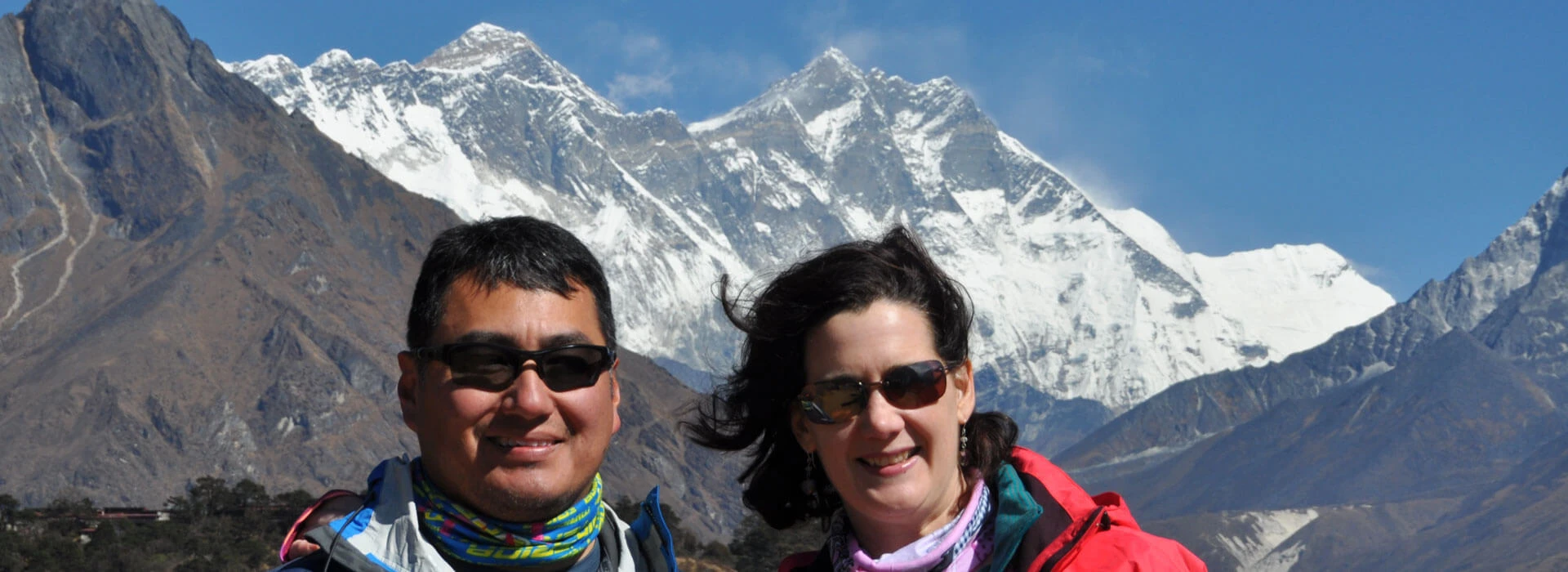
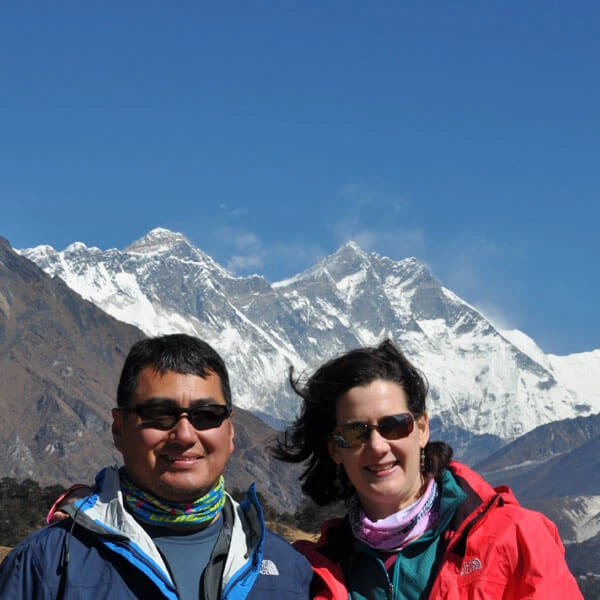
Everest Base Camp Family Trek is built around one simple idea: walking the trail side by side, at a shared, genuinely active pace, whether that's a parent and teenager, siblings traveling together, or a couple marking a honeymoon or anniversary. It follows the same spirit as the classic Everest Base Camp trek, just shaped around the specific joy of doing it as a group who already move at a similar rhythm.
Something genuinely different happens when you reach Base Camp and Kala Patthar with someone who matters to you, watching a teenager's face when Everest finally comes into view, sharing a quiet moment with a sibling at 5,364 meters, or starting married life with a story neither of you will ever tell the same way twice. Every family, sibling pair, or couple has a different reason for choosing the trail, but the trek gives back the same thing: seventeen days of shared effort, conversation, and the kind of memory that only forms when people push through something hard together.
The route itself adds real depth without losing focus, a quieter stretch through Phortse, close up mountain views from Chukhung, and an optional Kongma La Pass for anyone wanting more, but none of it matters as much as who you're walking beside when you finally reach the summit view. For groups traveling with young kids or older family members, dedicated guides on the Everest Base Camp Trek for Kids and Everest Base Camp Trek for Seniors cover those journeys in full; this piece is simply for people ready to walk it together, at their own natural pace, side by side.
- A complete Everest Base Camp journey built for families, siblings, and couples trekking together at a genuinely active pace
- A dramatic scenic flight into Lukla, one of the most thrilling short flights in the world
- A quieter, less crowded route through Phortse, a traditional Sherpa village most standard itineraries skip entirely
- Tengboche Monastery, framed by sweeping Himalayan scenery and centuries of living Buddhist tradition
- Namche Bazaar's lively market streets, bakeries, and teahouse culture, with a built in acclimatization stop
- A side trip to Chukhung, opening up dramatic close up views of Lhotse, Nuptse, and Island Peak rarely seen from the main trail
- An optional Kongma La Pass variant for trekkers wanting a more technical, high altitude challenge alongside the classic route
- Everest Base Camp itself (5,364 m / 17,598 ft), reached via the Khumbu Glacier's dramatic moraine landscape
- Sunrise at Kala Patthar, widely considered the best mountain viewpoint on the entire route
- Sweeping views of Everest, Lhotse, Nuptse, Ama Dablam, and the surrounding Himalayan giants throughout the trek
- Swinging suspension bridges, pine forests, glacial rivers, and yak trails woven throughout every stage of the journey
- Experienced guides and porters supporting the whole group, whether traveling as parents and teens, siblings, or a couple marking a honeymoon or anniversary
- A genuinely shared achievement, adventure, connection, and Himalayan scenery experienced together, at a pace built for active travelers rather than extreme age ranges
Beyond the Bucket List: Why EBC Is the Ultimate Bonding Ritual
Modern life has a strange way of keeping people close and distant at once, families sitting in the same room, each on a separate screen, couples scrolling side by side instead of talking. An Everest Base Camp family trek strips that pattern away almost immediately. Thin air, steady cold, and steep climbs don't care about the roles people play back home, and somewhere around Namche Bazaar, the usual hierarchy quietly dissolves. A parent stops being the one giving instructions and becomes a teammate struggling up the same hill. A husband and wife stop being two people managing separate schedules and become two people leaning on the same effort. The mountain doesn't care about your age; it asks for the same resilience from everyone, turning parents and children, or partners, into true peers.
Losing reliable Wi Fi turns out to be one of the trek's quiet gifts rather than an inconvenience. Evenings settle into teahouse life, gathered around a central stove, often burning yak dung for warmth at higher elevations, with nothing pulling attention toward a screen. Card games fill the hours instead, journals get written by candlelight, and conversations wander further than they usually do at home, comparing the day's best moments, planning tomorrow, or simply sitting together watching the last light disappear behind the peaks. Where home offers the dull fatigue of endless scrolling, the Khumbu offers stargazing instead, clear, high altitude skies unlike anything most travelers have seen before.
Small, repeated moments end up mattering as much as the summit photo itself. A shared cup of ginger lemon honey tea each morning while the guide maps out the day becomes its own quiet ritual. A high five at every big suspension bridge crossing becomes a running joke nobody wants to skip. Spotting the first yak caravan of the day and calling it out to keep everyone safely on the mountainside of the trail becomes a small shared game repeated dozens of times over two weeks. None of it feels significant in the moment, and all of it becomes the thing people remember most clearly years later.
What people actually walk away with runs deeper than a photo at 5,364 meters. For a parent and child, it becomes proof that hard things are possible, a new definition of capability neither one had before. For a couple, it becomes the origin story of a marriage or partnership, the trip retold at anniversaries for decades, the moment two people learned what they could carry together. You aren't just giving someone a trip; you're giving them a new definition of what they're capable of, together, side by side, with nowhere else to be but exactly where they already are.
Everest Base Camp Family Trek Cost: 17 Day 2026/2027 Pricing
A Family trek to Everest Base Camp in 2026/2027 typically runs $1,900 to $2,600 per person, depending on group size, season, and whether you book a shared departure or a private one built entirely around your own family, siblings, or partner. Since this itinerary moves at a more active pace than a kids or seniors focused route, without the extra built in rest days those trips require, pricing generally lands closer to a standard EBC trek than a specially paced family package, even with the added stops through Phortse and Chukhung.
The figure generally covers domestic flights between Kathmandu and Lukla, the Sagarmatha National Park and Khumbu Pasang Lhamu permits, teahouse accommodation and meals for all 17 days, and a guide and porter team for the full group. It typically excludes international flights, Nepal visa fees, personal travel insurance, and any optional add ons like the Kongma La Pass variant, which usually adds extra guide and equipment costs given the higher technical demand of that route.
A few factors shift the price beyond the base range. Group size matters considerably; larger sibling groups or extended families spread permit and guide costs across more people, while a couple trekking privately pays more per person for the same dedicated attention. Season plays a role too; spring and autumn carry higher demand and slightly higher flight and permit costs than the shoulder seasons. Choosing the Kongma La Pass extension adds real cost as well, since it typically requires additional guide support and, in some cases, basic technical gear like crampons and trekking poles suited to the pass's steeper terrain.
A handful of costs are worth budgeting separately, since they're easy to underestimate. Hot showers, Wi Fi, and device charging typically run a few dollars each once above Namche Bazaar, and these add up quickly across 17 days on the trail. Snacks, bar tabs, or the occasional bakery treat in Namche aren't included in most packages either. High altitude travel insurance with emergency evacuation coverage is essential for every member of the group and should be arranged well before departure rather than left until the final week.
As always, pricing shifts by operator, season, and group size, so confirming current figures directly before booking matters more than relying on last year's numbers. What the price ultimately buys goes beyond permits and porters; it buys a guide genuinely experienced with active groups moving at a shared pace, a route built to include quieter, less crowded stretches most standard itineraries skip, and the flexibility to add a real high altitude challenge for anyone in the group ready for it.
Everest Base Camp Family Trek with Helicopter Return to Lukla
Not every group has the time, or the interest, in retracing the same trail on the way back down after already reaching Base Camp and Kala Patthar. For families, siblings, or couples in that position, a shorter 14 day version of the EBC trek for families follows the identical route up to Base Camp, then swaps the multi day trek back for a scenic helicopter flight straight from Kala Patthar to Lukla.
Why choose the helicopter return?
Time constraints: Not every group can take a full 17 days away from work, school, or other obligations. The heli return version delivers the same summit achievement, Base Camp and Kala Patthar both included, in noticeably fewer days.
Reduced fatigue on the descent: By the time Kala Patthar comes into view, legs have already carried the group through nine demanding trekking days. Skipping the multi day walk back down means avoiding the added strain right when energy reserves run lowest.
Less appeal in repeating familiar terrain: Much of the descent retraces ground already covered on the way up. A helicopter return skips the repetition entirely, trading it for a genuinely different experience instead.
A memorable bonus adventure: For most travelers, a helicopter flight through the Khumbu ranks among the trip's most exciting moments in its own right, low altitude views over the same villages and ridgelines walked days earlier, seen from an entirely new angle.
14 Day Outline Itinerary
Day 01: Kathmandu arrival, 1,360 m
Day 02: Kathmandu sightseeing
Day 03: Kathmandu, fly to Lukla, trek to Phakding, 2,652 m, 3 hours trekking
Day 04: Phakding to Monjo, 2,835 m, 3 hours trekking
Day 05: Monjo to Namche Bazaar, 3,446 m, 4 hours trekking
Day 06: Namche Bazaar, hike to Everest View Hotel (4 hours), or trek to Khumjung village for an overnight stay via Everest View Hotel
Day 07: Namche Bazaar to Phortse, 3,850 m, 4 hours trekking
Day 08: Phortse to Dingboche, 4,084 m, 5 hours trekking
Day 09: Dingboche to Chukhung, 4,780 m, 3 hours trekking
Day 10: Chukhung via Dingboche and Thukla to Lobuche, 4,930 m, 5 to 6 hours trekking, or via the Kongma La Pass to Lobuche
Day 11: Lobuche to Gorak Shep, 5,160 m, then Everest Base Camp and back to Gorak Shep, 9 hours trekking
Day 12: Gorak Shep to Kala Patthar (2 hour hike), then helicopter flight to Lukla, 2,800 m, 30 minutes
Day 13: Lukla to Kathmandu, 30-minute flight
Day 14: Kathmandu departure
Cost of the 14 Day Family Trek with Heli Return in 2026/2027
The 14 day family trek itinerary with helicopter return typically costs more overall than the full 17 day walking version, despite covering three fewer days on the trail, since the helicopter segment carries genuine added expense. For 2026/2027, expect a per person price in the range of $2,400 to $3,200, with the shared helicopter transfer from Kala Patthar to Lukla adding roughly $500 to $700 on top of standard trekking package costs, permits, teahouse accommodation, meals, and guide and porter support.
Groups wanting a private helicopter charter rather than a shared seat should expect a meaningfully higher cost, since private flights are priced per aircraft rather than per person, and the exact rate depends heavily on group size and how the cost gets split. As with the standard itinerary, season and group size shift the final number too; larger sibling groups or extended families spread guide and permit costs across more people, while a couple booking privately pays a higher per person rate for the same dedicated support.
It's worth weighing the trade off honestly before choosing this option: paying more for three fewer days only makes sense if time, fatigue, or simple lack of interest in the return walks genuinely matter to your group. For travelers where those factors are real, the added cost tends to feel well justified by the time and comfort saved, and the helicopter flight itself becomes a genuine highlight rather than just a shortcut home.
When to Trek: Matching the Season to Your Route and Group
Choosing when to trek matters more on this itinerary than a standard route, since Phortse, Chukhung, and the optional Kongma La Pass each respond differently to seasonal conditions than the main trail alone. An Everest Base Camp family trek built around these extras rewards a bit more thought about timing than simply picking whichever window looks clear on a calendar.
Autumn (September to November) suits this route particularly well, especially for groups planning the Kongma La Pass variant. Post monsoon skies settle into some of the clearest visibility of the year, and snow conditions on the pass tend to be at their most stable, firm underfoot without the deep, unconsolidated snow spring sometimes brings. Chukhung's close up views of Lhotse and Nuptse also benefit enormously from autumn's consistent clarity, and Phortse's quieter trails stay genuinely pleasant rather than muddy. Autumn is also the busiest season on the main EBC route, worth knowing for larger sibling or extended family groups who benefit from a livelier trail atmosphere and easier logistics around teahouse bookings, but worth weighing carefully for a couple hoping for a quieter, more private experience.
Spring (March to May) offers a genuinely different character. Rhododendron forests bloom vividly through the lower stretches near Phortse, adding real color the autumn trail doesn't offer, and temperatures run slightly milder overall. The Kongma La Pass remains a viable option in spring too, though snow conditions can be softer and less predictable than autumn's firmer pack, worth discussing directly with a guide closer to departure. Spring draws a somewhat smaller crowd than peak autumn, making it a stronger fit for couples wanting a quieter trail without sacrificing much in terms of weather reliability.
Winter (December to February) turns the Kongma La Pass into a genuinely technical undertaking rather than a moderate challenge; heavy snow, extreme cold, and shorter daylight hours make the pass considerably riskier, and most operators recommend skipping that variant entirely during winter months. The main trail through Phortse and Chukhung remains walkable, and winter's near empty trails appeal strongly to couples or small groups prioritizing solitude above all else, provided the group comes prepared for genuinely harsh cold at the higher camps.
Monsoon (June to August) is worth avoiding regardless of group composition or route choice. Heavy rainfall, leech prone lower trails, and near constant cloud cover erase the mountain views that make Chukhung and the pass worthwhile in the first place, while frequent Lukla flight delays add real risk to a tighter itinerary.
Ultimately, the right season depends on what your group values most. Larger family or sibling groups tend to do best in autumn, when logistics run smoothly, and the trail's social energy suits a bigger party well. Couples chasing privacy and a quieter pace often find spring or even winter more rewarding, provided the Kongma La Pass gets reconsidered or dropped when conditions turn unpredictable. Whichever window fits, checking current trail and pass conditions with your operator close to departure remains worth doing regardless of season.
The Everest Equalizer: How the Khumbu Bridges the Gap Between Teens and Parents
Somewhere around 4,000 meters, the usual family dynamic quietly falls apart. At home, a parent holds the role of provider and rule maker; on the trail, the mountain takes over that job entirely, and both parent and teenager end up equally out of their depth, gasping for air on the same steep switchback. Watching a parent struggle, sweat, and push through real fatigue does something a teenager rarely gets to witness: it makes them human. A family trek to Everest Base Camp builds a kind of empathy between generations that ordinary suburban life, school runs, homework, and curfews rarely create.
Losing reliable Wi-Fi turns out to matter more for this particular bond than almost anything else on the trip. Without TikTok, Snapchat, or a group chat pulling attention elsewhere, a typically monosyllabic teenager gets handed something unfamiliar: hours of open trail and nothing to look at except the horizon, and the parent walking alongside them. Six hours of daily walking becomes uninterrupted conversation, and it tends to happen sideways, shoulder to shoulder on the trail, rather than face to face across a dinner table where teenagers often clam up.
The physical demands of the route do their own quiet work too. Struggling up the infamous climb into Namche, pushing through a cold night at altitude, or finishing a long, exhausting day all become small, repeated tests of resilience. When a teenager sees a parent genuinely proud of them for finishing something hard, it lands differently than praise handed out at home. And when the roles flip, a teenager encouraging a parent who's struggling, something shifts too, a flash of real maturity neither one expected to find on a mountainside.
Watching how Sherpa teenagers actually live, carrying loads, working in family run teahouses, going to school hours from home, opens up conversations about gratitude and perspective that never quite land the same way as a lecture at the dinner table. Out here, the comparison speaks for itself, and neither parent nor teenager needs to force the point.
None of it stays behind on the mountain, either. Reaching Base Camp together becomes a shared victory rather than an individual one, the kind of inside story a family carries home and references for years, a secret language built from nine days of struggle and encouragement neither generation experienced quite the same way alone. The mountain doesn't care about a report card or a job title; it only asks for the next step, and somewhere in taking that step together, the usual distance between parent and teenager quietly closes.
The Sibling Reset: Reclaiming Your Original Team in the Heart of the Himalayas
Old labels have a way of sticking long after they stop being true: the bossy older sister, the irresponsible younger brother, roles assigned decades ago that somehow never got updated. Thin air has little patience for any of that. Somewhere on the climb into Namche, those childhood roles quietly fall away, replaced by something more accurate: two adults, equally out of breath, equally out of their comfort zone, seeing each other as teammates rather than the people they happened to grow up with.
Seventeen days of walking together create something modern sibling relationships rarely get anymore: real, uninterrupted conversation, the kind that doesn't survive a group chat or a rushed holiday dinner. Six hours a day on the trail opens space for the deep dive: parents, childhood, the future, subjects that never quite surface in an hour over a meal but unfold naturally somewhere between Phakding and Namche Bazaar.
Shared history collides with present hardship in a way that lands harder than either one alone. Looking at a sibling struggling up a steep pitch and saying "remember when climbing that hill in the park felt impossible?" carries real weight out here, a small, specific bridge between a childhood memory and a genuinely difficult present moment, walked side by side.
Whatever rivalry survived into adulthood tends to quietly die the moment someone develops a headache at 4,000 meters. Competing stops mattering; caring takes over instead, sharing water, carrying a bit of extra gear, offering the kind of encouragement siblings don't always extend to each other back home. And somewhere along the trail, the trip starts generating its own currency, yaks in sweaters, a particularly memorable teahouse owner, the sheer shared exhaustion of day nine, the kind of inside jokes that outlast every family gathering for the next twenty years.
Siblings don't just walk to Base Camp together. They walk back into each other's lives, rebuilding something that distance and adulthood had quietly let drift.
Romance in the Raw: Why Couples Are Trading Infinity Pools for Glacial Peaks
A beach honeymoon is about looking good. Seventeen days on the Khumbu trail is about being seen at your rawest, windburned, dusty, breathless, with no mirror checking any of it. Watching a partner push through genuine exhaustion, and still feeling the same pull toward them at the end of a hard day, carries a kind of intimacy no candlelit dinner quite manages to fake.
The trail doubles as a fairly honest metaphor for a relationship, some days downhill and sunny, others uphill in a snowstorm. Supporting each other through an altitude headache, a freezing night at Gorak Shep, or a long, silent stretch of exhaustion proves a kind of teamwork no resort itinerary ever tests. And reaching the prayer flags at Base Camp together lands as a shared win rather than a personal one, an anchor a couple can return to on harder days back home: we made it to Everest, we can handle this.
Romance narrows down to something simpler out here, a shared thermos of ginger tea, huddling together by a stove for warmth, a freezing teahouse balcony under more stars than either partner has likely ever seen at once. None of it costs anything close to what a resort dinner does, and somehow it tends to matter more.
Limited Wi-Fi does its own quiet work on the relationship too, without a feed to update or a follower count to consider, attention drifts back to where it belongs, a partner's voice, the sound of wind against a teahouse window, seventeen days that end up feeling less like a trip and more like an uninterrupted conversation neither one wants to end.
The Journey Between: Lukla, Namche, and the Heart of the Khumbu
The trail to Everest Base Camp was never really one long walk toward a single destination. It unfolds instead as a string of distinct, unforgettable places, each one leaving its own mark before the trek even reaches its highest point. An Everest Base Camp family trek moves through five moments in particular that tend to stay with a group long after the flight home: a runway carved into a mountainside, a town built like an amphitheater, a warm room at the end of a cold day, a monastery wrapped in chanting and silence, and a bridge swaying hundreds of feet above a roaring river.
The Lukla Leap
A hush falls over the small sixteen seat plane as the runway at Tenzing Hillary Airport comes into view, a short, sloped strip carved into the mountainside, ending abruptly against a wall of rock. Engines groan against the incline on final approach, and for a few seconds, every conversation on board stops at once. Landing here, at 9,383 feet, feels less like arriving somewhere and more like being dropped straight into the mountains themselves. Stepping off the plane brings the first real sense of the Khumbu: woodsmoke drifting through crisp morning air, prayer flags snapping against a cold breeze, the distant thud of a helicopter somewhere up the valley, porters already hoisting duffel bags onto their backs. Somewhere in that first breath of thin mountain air, the trip stops being a plan and becomes real.
Namche Bazaar: The Last Taste of Modern Comfort
Namche Bazaar unfolds in a dramatic horseshoe shape, houses and shopfronts stacked up a natural amphitheater carved into the hillside, terraces of stone and tin roofs climbing toward the sky. Known as the Sherpa capital of the Khumbu, it remains the last real outpost of modern comfort before the trail climbs into quieter, higher terrain, a place where the ordinary world briefly reappears before disappearing again for good. Bakeries sell warm apple pie and thick slices of chocolate cake at 11,286 feet, the smell of fresh bread drifting out onto stone streets crowded with trekkers, porters, and mule trains. Market stalls stock any last minute gear a group might need: a warmer hat, extra sunscreen, one more pair of wool socks. And the hike up to the Everest View Hotel delivers the trip's first genuine glimpse of Everest itself, a distant, dark pyramid rising above the surrounding ridgelines, quiet confirmation that the mountain everyone came for is finally, actually visible.
Teahouse Evenings on the Trail
Each teahouse settles into its own version of the same quiet ritual come evening, a dining hall warming slowly around a central stove, plywood walls doing little to block the cold outside, shared bathrooms down the hall, boots lined up by the door still damp from the day. It isn't luxury, and it was never meant to be. Steam rises off bowls of soup, headlamps flicker on as darkness falls early, and the low hum of conversation from other trekking groups fills the room alongside the smell of woodsmoke and drying gear. What a teahouse offers instead of comfort in the usual sense is something closer to shelter in the truest meaning of the word: a warm room, a hot meal, and a place to rest before another demanding day begins.
Tengboche Monastery
Long copper horns and monks chanting fill the air at dawn and dusk in Tengboche, a low, resonant sound carrying across the courtyard and settling the whole group into stillness almost immediately. Many consider it the most beautiful stop on the entire route, Ama Dablam rising directly behind the monastery in one of the Khumbu's most striking backdrops, its sharp summit catching the day's last light long after the valley below has gone dark. Lighting a butter lamp here, a small, flickering gesture for a safe journey ahead, marks the moment the trek quietly shifts from something purely physical into something closer to spiritual, a pause built into the itinerary that asks for nothing but presence.
Crossing the Khumbu's Suspension Bridges
The Hillary Suspension Bridge sways gently underfoot, draped in thousands of weathered prayer flags, hanging hundreds of feet above the Dudh Kosi River far below, its churning water barely audible over the wind. Crossing it tests nerve as much as balance, and it's rarely done in silence, a steadying hand reaching back for another, a shout of encouragement carried forward, footsteps timed carefully to the bridge's slow, rhythmic sway. Yak caravans cross these same paths constantly, forcing a brief, practiced pause against the mountainside, bells jingling past at close range, heavy loads swaying with each step before the trail opens up again on the other side. Between the wind, the flags, and the long drop below, these crossings tend to stay etched in memory long after the rest of the day fades into the background.
Kala Patthar: The Sunrise Everyone Came For
Darkness still covers the trail as the group sets out for Kala Patthar, headlamps bobbing in a slow line up the final ridge, breath visible in the freezing pre dawn air. Reaching the top means arriving to nothing but silhouette and starlight at first, until the horizon begins to shift, a faint gray line, then gold, then a wash of color spreading across the sky. Everest itself finally appears in full, no longer a distant shape glimpsed from Namche, but a towering wall of rock and ice catching the very first light of day, Lhotse and Nuptse rising alongside it in a panorama few places on earth can match. Nobody speaks much in that first minute. There's rarely anything worth saying that the view doesn't already say better.
Everest Base Camp: The Surprising Truth About the Destination
Reaching Base Camp itself often catches trekkers off guard, not because it disappoints, but because it isn't what most people expect. Everest can't actually be seen from here, hidden behind the shoulder of Nuptse, and during peak climbing season, Base Camp transforms into a sprawling, colorful city of expedition tents, ropes, and gear rather than a quiet, solitary summit. It's noisier, busier, and far more human than the postcard image suggests. And somehow, none of that takes anything away from the moment.
What actually lands, standing among the prayer flags at 5,364 meters, isn't a perfect mountain view. It's everything that led here, seventeen days of shared effort, cold mornings, tired legs, small victories, and quiet conversations along the trail. People who've made this trek before tend to say the same thing afterward: Everest Base Camp was never really about the destination. It was always about the journey. And a journey shared with the people who matter most- a parent, a sibling, a partner doesn't just reach Base Camp. It becomes the story that outlasts the summit photo entirely.
Who You'll Be Trekking With: The Team Behind the Journey
A trek this demanding depends entirely on who's leading it, and Nepal Nomad has been organizing Himalayan journeys out of Kathmandu since 2006, nearly two decades spent guiding families, siblings, and couples through exactly this kind of terrain. A family trek to Everest Base Camp covering Phortse, Chukhung, and an optional high pass calls for guides who know the route intimately, not just the standard trail everyone else walks.
Every guide holds proper licensing and genuine, on the ground familiarity with the Khumbu, insight that shapes real decisions on the trail: when to slow the pace for a struggling member of the group, when the Kongma La Pass is genuinely safe to attempt, when a rest day matters more than pushing forward. Porters carry the physical load, keeping daypacks light for the whole group, while guides focus entirely on pacing, safety, and the small moments that turn a demanding trek into a genuinely memorable one.
What comes through most in client feedback isn't polish; it's personal attention. Trekkers returning for a second or third trip often mention working directly with the company's founder, someone who treats each itinerary as a real conversation about what a group actually wants, rather than a fixed package handed over unchanged. That same approach carries through guide and porter teams on the ground, small enough to stay attentive, experienced enough to handle whatever nine days above 4,000 meters actually demands.
Flexible rebooking options and a genuinely customer first approach round out the practical side, but the real reassurance comes from something harder to fake: a company that's spent two decades in the Khumbu, watching thousands of families, siblings, and couples walk this same trail, and learning exactly what it takes to get every one of them to Base Camp safely, together.