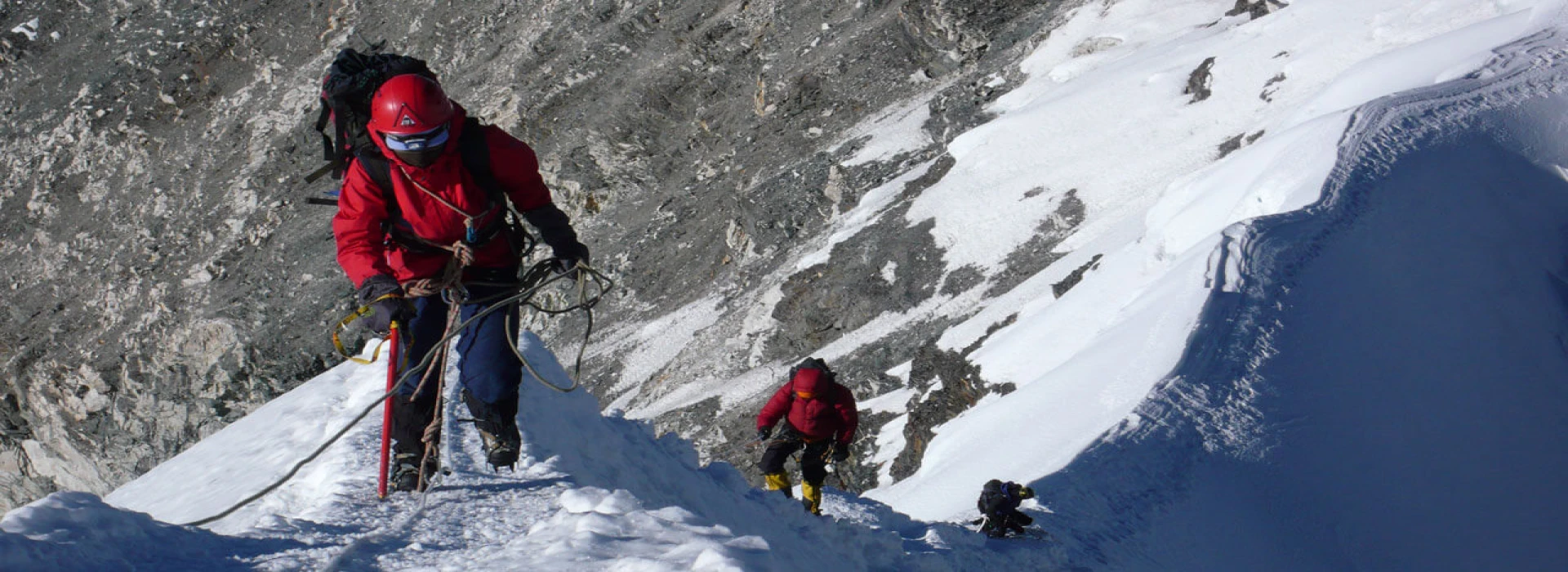
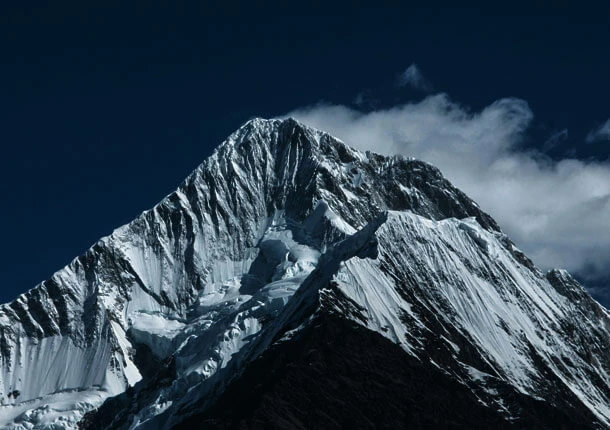
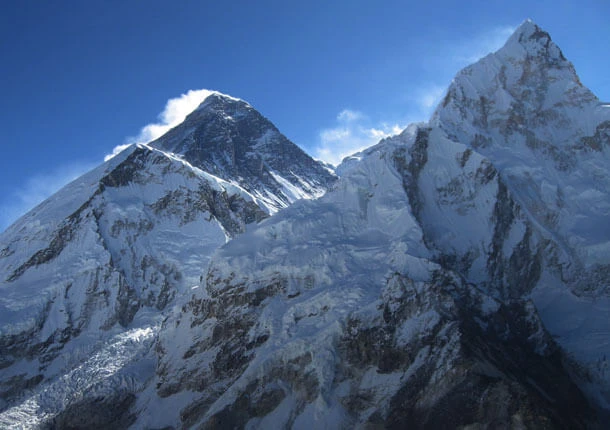
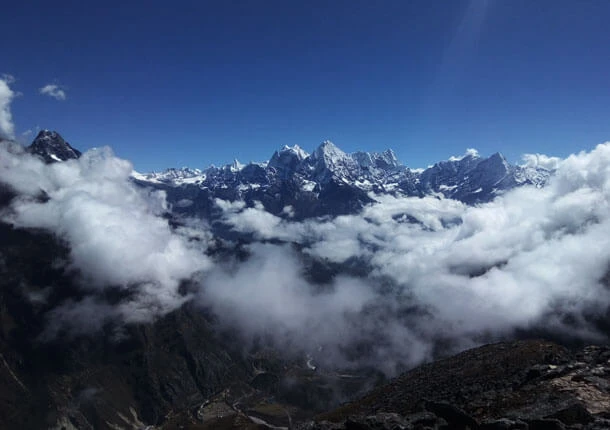
Set in the heart of Khumbu, this three Himalayan expedition consisting of Pokalde (5,806m, 19,049ft), Lobuche (6,119m, 20,075ft), and Island Peak (6,189m, 20,305ft), is a perfect blend of high altitude challenge and Himalayan poetry. It is considered one of the best value for money mountaineering adventures in Nepal, and as of 2026, the estimated Everest Three Peaks climbing cost is $6500 to $7,500 when booking with a reputable agency like Nepal Nomad.
Prices vary by operator, season, group size, service level, and inclusions like guides, gear, and permits. Nepal Nomad's standard package includes comfortable lodging, Lukla flights, Three Meals a day, Sagarmatha permits, and experienced guides. For the peak seasons spring and autumn, the permit for a 6,000m peak like Lobuche East or Island Peak costs $350- 175 USD per person.
Transportation and logistics are other factors that affect the total cost. A round trip flight between Kathmandu (or Manthali in peak seasons) and Lukla costs approximately $400 to $450 USD. Similarly, once on the trail, your daily expenses, including accommodation and three meals a day, will average between $80 and $90 USD as you move higher into the valley. For the summit pushes, your operator will set base camps and the price of transporting gear, via porters is usually included in your package, which accounts for roughly $6500 to $7,500 of the total expedition price.
Finally, personal and safety requirements add a final layer of expense. Buying or renting technical gear like double mountaineering boots, crampons, ice axes, and high altitude down suits, a specialized travel insurance that covers mountaineering up to 6,500 meters, personal treats like Wi-Fi, hot shower, occasional drinks and extra meals are some of the factors that make a significant difference in your final Everest Three Peaks expedition price.
Budget vs Standard Everest Three Peaks Climbing Packages
When choosing between a budget and a standard package for the Everest Three Peaks cost 2026, the key price difference highlights the level of safety you prefer, the quality of your itinerary (gaps between days to recover between climbs), and the service of the guiding staff. The Budget package typically ranges from $6000 to $6500 per person, designed for climbers who prefer quality support without extra comforts. Standard packages ranged between $7000 to $7500, focused more on comfort and personalised services.
The budget or the base level package provides one guide for a group of four or five and a climbing guide during technical sections. It offers a standard hotel during your stay in Kathmandu, basic teahouses on trek sections, a set three course meal, a basic first aid kit and emergency response plan, and a less flexible schedule for rest days. The packages cover peak permits and government fees, climbing ropes and fixed lines and shared group gear for camps.
Standard or Nomad package has a higher guide ratio, one to two and is dedicated to all critical points and helps in personalised pacing and safety monitoring. The food and accommodation includes three star hotel stay in Kathmandu, upgraded lodges, more varied meals, and priority service. It also offers high quality personal climbing gear, priority fixed ropes and better communication gear like a satellite phone and GPS. The package includes an enhanced medical kit, a customised acclimatisation plan, buffer days for weather, and personalised summit push timing.
Which one should you choose while budgeting Pokalde Island Lobuche climbing cost? Well, there is no exact answer. Choose a budget friendly package if you are an experienced climber, want quality support without extra comfort and are cost conscious. Choose standard one if you prefer a high guide support, want better rest, flexibility and meals, and are a new climber.
Comparing Costs: Local Agencies vs. International Operators
Both Nepali agencies (Nepal Nomad) and international operators offer Three Peaks Nepal climbing price packages, but they vary significantly in pricing structure, client experience, support services and inclusions. Choosing between depends on your budget, preference, expectations and comfort below.
Here is the table that shows the complete facilities offered by both operators.
Features | Local Agency (Nepal Nomad) | International Operator |
Total cost | $6500 to $7500 USD | $9900 to $11500 USD |
Directness | You are a direct client. | The operator hires local agency as a ground handler. |
Modes of Payment | Bank transfer and credit card pay to Nepal. | Credit card, Bank transfers to western accounts. |
Guiding Personnel | A senior Sherpa with multiple NMA certified trainings and Everest summits, varying level of English proficiency but with unmatched knowledge of local traditions, culture, monasteries and shortcuts. | A western professional plus a team of senior Sherpas with a native or fluent English/European languages. |
Safety Protocols | Follows Nepal government mandates, carries basic first aid and a pulse oximeter. | Follows strict western medical protocols and carries a comprehensive medical kit. |
Food and Lodging | Uses standard tea houses and local tea houses menus. | Often books best in class lodges months in advance and often bring their own supplement snacks. |
Choosing between them is not just about the final Everest Three Peaks climbing cost; it is also about the kind of mountain climbing experience you desire. While international agencies bring comfort, a global support network and structure, local agencies excel at efficient, authentic, cost effective arrangements and knowledge based trips.
How Much Are Everest Three Peaks Permit Fees And Domestic Flights Cost in 2026?
For the Everest Three Peaks cost 2026, the Nepal government and the Nepal Mountaineering Association have implemented fixed prices. The main reasons are the improvements in infrastructure and safety, environmental conservation, regulation of climbing traffic, support for local communities and rising operational costs. So, how much is the Everest three peaks permit cost in 2026?
Permits required for the Pokalde Island Lobuche climb are Peak Climbing Permits, Khumbu Pasang Lhamu Rural Municipality Fee and Sagarmatha National Park Entry. The rate in 2026 is USD 350 per person in spring, which is the peak season, USD 175 per person in autumn and USD 175 per person in Winter/Summer (usually not recommended). Similarly, Sagarmatha National Park Entry Permit costs $ USD 30 (approx. 3,000 NPR) and Khumbu Pasang Lhamu Rural Municipality Fee is $30 USD (approx. 3,000 NPR).
Additionally, a Garbase Deposit cost, a $500 refundable deposit, is required per peak to ensure that each individual is responsible for the preservation of the Himalayas; climbers must carry all their waste back with them.
Likewise, the Lukla flights are one of the most expensive domestic routes in Nepal due to the technical nature of the airport and high demand. The round trip price from Kathmandu to Lukla is between $430 to $480 USD. As most flights during spring and autumn depart from Manthali (Ramechhap) because of high demand, you have to take a 5 to 6 hour drive that can cost between $25 and $40 USD per person. Also, if fixed wing lanes are grounded because of weather, you can fly via helicopter, but they can be very costly, up to $600 USD per person.
The Insurance Gap: How Age Affects Your Premium and Evacuation Costs
Insurance plays a vital role in budgeting your Everest Three Peaks expedition price. Proper Insurance is not just a recommendation but a mandatory requirement for obtaining climbing permits and a crucial safety net. You require the specialized mountaineering insurance as standard travel insurance often excludes mountaineering with technical equipment. For the Khumbu Three Peaks, you are at a high risk of High Altitude Pulmonary Oedema, and without a policy that explicitly covers these risks, you could face financial ruin in addition to a medical emergency.
For this expedition (Everest Three Peaks Climbing), your policy must include an altitude limit up to 6,000m, search and rescue, helicopter evacuation, technical climbing, and Medical Repatriation. While insurance is essential for all climbers, age significantly affects premium costs and coverage limits. The under 40 age bracket is considered low risk and can cost $200 to $350 USD. Policies are generally easy to obtain online without medical declarations.
The insurance cost for the 40 to 60 age bracket has increased by 15 to 13 percent between $400 to $650 UDS, reflecting a higher risk of heart or joint issues. You have to disclose your medical history, new medical checkups or declaration. For seniors above 65, the cost gap becomes a chasm. It is estimated between $800 to $1500 USD. You will likely be asked to submit a medical fitness certificate signed by a doctor, including a stress ECG (electrocardiogram).
Age | Coverage level required | Average Insurance cost | Medical Requirements |
18 to 39 | Standard Technical up to 6,500m | $250 | None |
40 to 59 | Enhanced Technical up to 6,500m | $500 | Basic Health Check |
60 to 69 | Specialist High Altitude | $900 | Stress ECG and Doctor’s Sign off |
70 plus | Elite Evacuation | $1,500 | Full Medical Screening |
Not only the insurance premium but the hidden costs of a potential evacuation also change with age and can ultimately affect the overall Pokalde Island Lobuche climbing cost. For example, an older climber after evacuation for AMS is often kept in a Kathmandu hospital for two to three days just as a precaution, whereas a younger climber can get discharged within 24 hours depending upon the physical condition and the recommendation of a doctor, these extra days in the hospital can add up to $100 in out of pocket expenses.
Pokalde Island Lobuche Climbing Cost Varies By Season
When planning for the Three Peaks Nepal climbing price, the season you choose is the single most significant factor in determining your final invoice. While the trekking route remains the same with the exception of Lukla flights, the permit fees, agency services rates, food and accommodation prices fluctuate based on the demand of the season.
While both spring and autumn are considered the best seasons for the Three Peaks adventure, it is strongly recommended that you avoid winter and the summer/monsoon season. Although a few elite mountaineers choose winter for the sake of solitude, summer and the monsoon season are strictly not recommended because of high risk of landslide and avalanches.
In the climbing world, spring (March to May) is considered the premier season as it coincides with the Everest climbing window, while autumn is preferred season for photography climber because of clear skies. For 2026, a permit for a 6,000m peak like Island Peak or Lobuche East in spring costs $350 USD per person and in autumn, the cost is $175 USD per person.
Similarly, in both seasons, the demands for climbing guides, Sherpa support, and teahouse accommodation peak across the Khumbu region, and the prices vary based on that. In Spring and Autumn, the higher cost is mostly driven by increased operational expenses, demand for experienced staff, and limited availability of flights and accommodation in the Everest region.
Staff, Tips, and Gear: The True Cost of the Three Peaks
While the set price of Everest Three Peaks climbing cost based on the package of your choice covers your basic food, lodging, and permits, the significant secondary expense is the reality of an alpine climb. The price of staffing logistics, the customary tipping culture, and the technical gear required easily adds up to $3000 to your total budget.
In Nepal, having a guide is mandatory, and you are responsible for their well being. A professional climbing Sherpa earns between $40 and $50 USD per day plus summit bonus $300- $500 USD per peak. You also need a porter to carry heavy gear that is not used during the trekking phase, and expect them to pay $20 to $30 per day. Similarly, every staff member (Guides, Porters and Cooks) must be insured by law, and your operator also subsidies in an equipment allowance to ensure your staffs have recommended gear. This usually adds $400 to $500 to a group's total cost.
Although the tipping is not mandatory in the Himalayas, it is a structured part of the local economy and you are highly recommended to budget for these in cash (USD or NPR). A general rule is $10 to $15 per day of the trip, so, for a 29 day trek, the total for tips is roughly $300- $500.
Everest three peaks climb requires specific technical equipment and that covers a significant part of your total budget. You can either buy or rent the gears in Kathmandu Thamel and in Namche Bazaar, but in Namche, the options can be limited.
If you are planning to continue mountaineering, then we suggest you to buy for longevity: a 6000m Double Boots ($700 to $900), Down Suit or Heavy Down Parka ($600 to $1,000), Technical Kit (Crampons, Ice Axe, Harness, Jumar/Ascender, Carabiners, Helmet) ($500 to $700). However, if you are on a once in a lifetime expedition, then rent the gear: Daily/Per Trip Rental (Boots, crampons, axe, harness, helmet) for roughly $250 to $400.
Also, consider the many hidden expenses that can add $500 to $1500 to your final Everest Three Peaks cost 2026 bill. Your teahouses will charge you ($2 to $5) per hour for every electronic device you charge. You have to buy Everest Link Wi-Fi cards, which can cost $10 to $ 25 for 10GB to 20GB. Hot showers are considered premium luxury, and high altitude lodges will charge $5 to $10 per hot shower. An occasional Khumbu treat can also add a few extra on your budget plan. Unique Himalayan cuisines, a heartfelt souvenir, occasional bakery treat at high altitude are a few examples.
Wrapping Up Your Pokalde Island Lobuche Climbing Cost Plan
In conclusion, budgeting for the Three Peaks Nepal climbing price is a balance between the quest for adventure and the necessity of safety. While the sticker price is available as per the package of your choice, always remember to add international flights, specialized insurance, technical gear, and the customary tipping culture in your final invoice.
The final cost of your trip will ultimately defined by strategic choices Seasonality vs. Savings (choose the season with consideration of cost and how much you can save rather that the popularity), Safety vs. Service (always give primary focus on safety as nothing is bigger than your life) and Preparation vs. Performance (invest in a comprehensive policy and reliable equipment so that your financial risk is managed as carefully as your physical risk.)
At the end of the day, the Everest Three Peaks expedition price is more than a number; it is an investment in preparation, safety, and the rare privilege of moving high among the Himalaya.