Where Is Hotel Everest View, and How High Does It Sit?
Hotel Everest View sits on the Syangboche ridge inside Sagarmatha National Park, in Nepal's Solukhumbu district, directly above Namche Bazaar. At 3,880 meters (12,730 feet), it stands roughly 440 meters higher than Namche, almost level with Tengboche Monastery at 3,860 meters, and far below Everest Base Camp at 5,364 meters. Kathmandu lies about 2,500 meters lower at 1,400 meters, and Lukla about 1,000 meters lower at 2,860 meters, so the jump from the capital's streets to the hotel's terrace is large.
Three neighbors define the area. Syangboche airstrip, at about 3,780 meters, lies just below the hotel and serves helicopters. Khumjung, the largest Sherpa village in the Khumbu, sits about twenty minutes away on foot, according to the hotel, and Namche Bazaar waits below, two to three hours down the trail. Visitors arrive on foot or by helicopter, and the walk is part of the charm.
Is It Really the World's Highest Hotel?
Guinness World Records listed Hotel Everest View in 2004 as the highest-placed hotel in the world, and the title has followed it ever since. Rankings of "highest" change with definitions, though. Some sources report hotels built higher since, and others limit the claim to luxury hotels, so the safest description is one of the highest hotels on Earth. The exact title matters less than the experience: few hotels anywhere put the world's highest mountain outside the bedroom window.
The Man Who Bet on a View
The story starts in the spring of 1968, when Japanese entrepreneur Takashi Miyahara stood on the Syangboche ridge and saw the whole Everest range at once. He imagined a hotel there, a place where visitors could take in the Himalayan panorama in comfort, and Japanese architect Yoshinobu Kumagaya designed it, a simple, elegant building meant to sit quietly in its surroundings.
Building it was another matter. No roads reached the ridge, so porters carried materials on a two-week walk from Lamosangu, about 80 kilometers from Kathmandu, and helicopters carried some of the rest. Glass for the solarium, sliding glass doors for the rooms, utensils, and blankets arrived from Japan, and one account describes supplies traveling by way of Kolkata and Kathmandu. Local Sherpas played a huge role, and the project took several years before the doors opened in 1971.
Miyahara died in November 2019, but his idea still stands on the ridge. He wrote a book about it, called Himalaya no Tomoshibi, usually translated as The Ray of Light in the Himalayas, and the title fits a hotel that has welcomed travelers for more than fifty years.
The Boulder in the Dining Room
One detail turns the dining room into a small story. A black wall inside is formed from an ancient boulder that originally sat on top of the ridge, and the stone carries a Tibetan Buddhist inscription, Om Mani Padme Hum. The hotel kept the boulder in place, so you eat beside a rock that stood on the ridge long before the first guest arrived.
Om Mani Padme Hum is the best-known mantra in Tibetan Buddhism, carved on mani stones and painted on prayer walls across the Khumbu, so the inscription links the hotel to the Sherpa landscape around it. Nobody needs to invent a legend for the boulder, since the plain facts are enough: a ridge, a stone, a mantra, and a building that made room for all three.
The Window: What You See and When
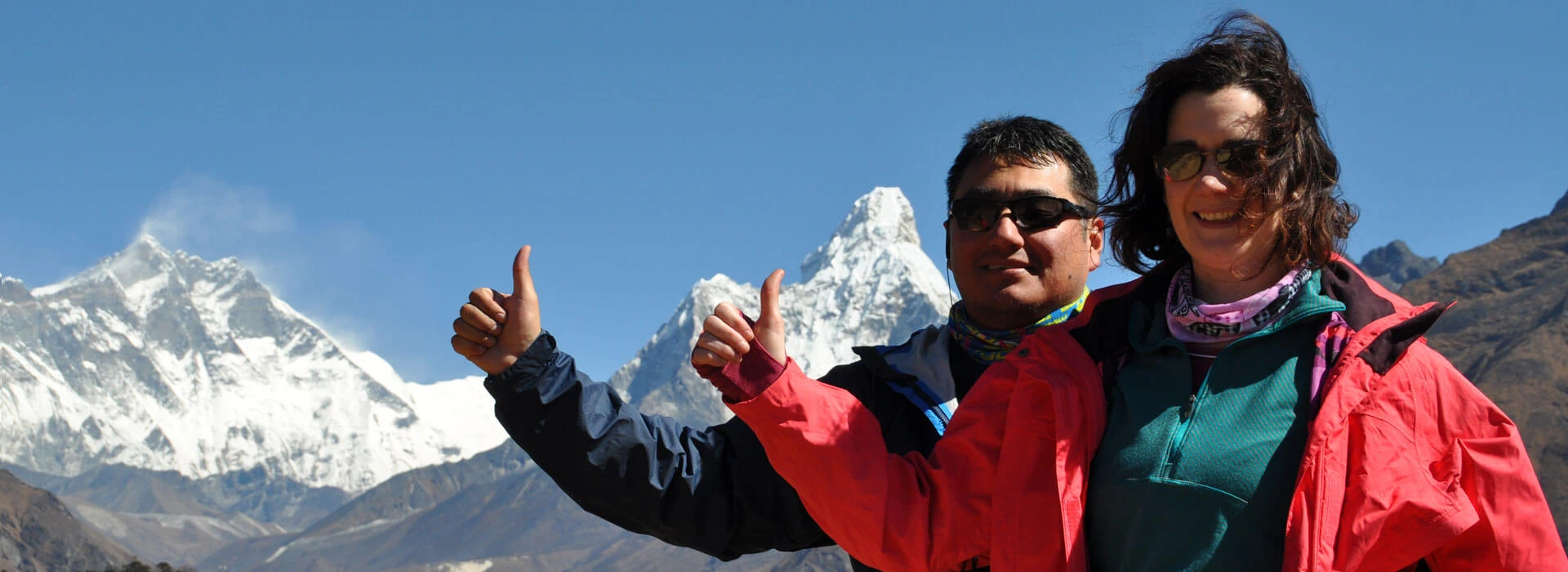
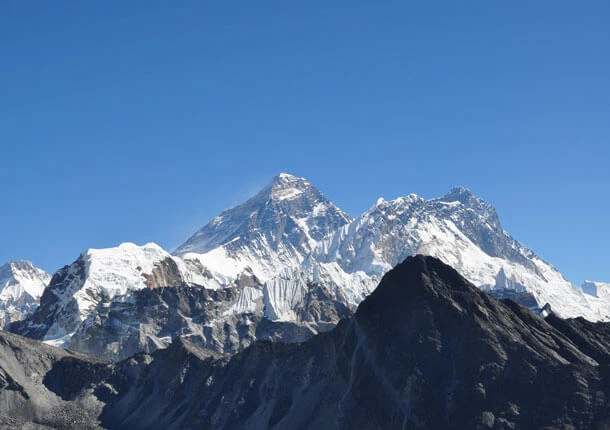
The view stretches far beyond Everest. The world's highest mountain rises beyond the long wall of Nuptse and Lhotse, a dark pyramid that looks smaller than photographs suggest and somehow more real for it. Lhotse stands beside it with its enormous face, Nuptse forms the ridge in front, and Ama Dablam, with its elegant, sculpted shape, often draws the eye before Everest does. Thamserku and Kangtega add depth across the valley.
The mountains change character through the day, so the hour matters as much as the season.
- Dawn: the air is crisp, the sky is usually clearest, and first light turns the summits gold. Early arrivals have the best chance of an unbroken view.
- Mid-morning: sunlight warms the terrace, tea arrives, and clouds begin to gather in the valleys below.
- Afternoon: cloud often drifts up and hides the summit, so a late arrival risks a gray panorama.
- Evening: on clear days, the last light touches the peaks, a reward for guests who stay the night.
Weather is never guaranteed, even in the best seasons, so treat a clear view as a gift instead of a promise.
Four Ways to Arrive at Hotel Everest View
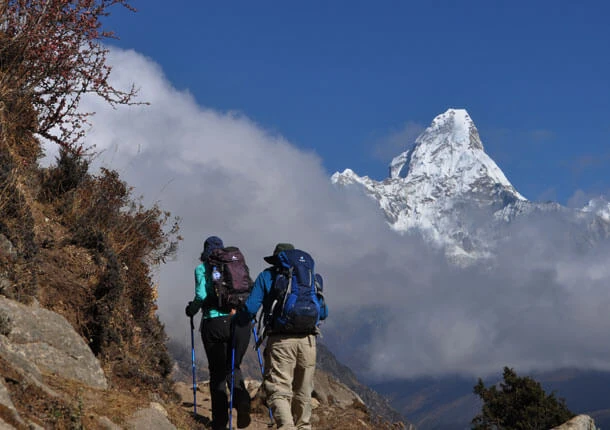
Walk up from Namche Bazaar. The classic approach climbs two to three hours through pine forest and past prayer flags, with Ama Dablam and Thamserku appearing as you gain height. Trekkers love it as an acclimatization day because the climb gains altitude by day while the return leads back to sleep lower in Namche. The Namche trek is a short way to enjoy the town and the walk.
Make it a loop. Khumjung lies about twenty minutes beyond the hotel, and Khunde sits just past it, so a longer loop adds villages, a monastery, and a school to your morning before you descend to Namche.
Fly in by helicopter. Helicopters land at Syangboche airstrip, and the hotel also describes a helipad. Short tours bring guests in for breakfast before flying on, and the one-day Everest Base Camp helicopter tour includes a breakfast stop here. The hotel's own site also describes chartered helicopters from Kathmandu and, in spring and autumn, a shuttle between Lukla and Syangboche. Landing rules in the Khumbu have shifted in recent years, so confirm arrangements before you book.
Make it part of a trek. Many trekkers visit on the way to Base Camp, and the Everest View trek builds the hotel into a nine-day itinerary. Others add it as a rest day on the Everest Three High Passes trek, since the hike sits on the same hillside as Syangboche.
Rooms, Meals, and What a Mountain View Costs
The hotel has twelve rooms, each designed to face the mountains. Rooms have en suite bathrooms, a sitting area, a dressing area, and a small study section, and stone-walled balconies look out toward the range. Electric blankets, room heaters, thermos flasks, charging slots, and free WiFi are listed among the amenities, along with laundry service, a bar, and a souvenir shop. At nearly 3,900 meters, a warm bed and a heated room matter more than a minibar, and a large window turns a quiet evening into an experience.
Food is part of the story. The dining room is open to every traveler in the region, guests or not, and it seats about thirty inside and fifty on the terrace. Menus mix Nepali breakfasts, continental breakfasts, club sandwiches, and fillet mignon with Japanese oyakodon, a nod to the hotel's heritage. Lunch and dinner offer dal bhat, thukpa, Newari khaja sets, sel roti, pizza, pasta, and buffets, so even a day visit feels like a proper meal with a view.
Costs vary with the season and the package. Operators quote from about US$320 per person for a twin-share night that includes two breakfasts, one lunch, one dinner, a guided visit to Khumjung Monastery and Namche, and permits, while single rooms run above US$500 per person. Celebration extras such as cakes, champagne, and decorations cost more. Spring and autumn rooms fill early, so book well ahead, and confirm current rates with the hotel or your agency.
Day Visit or Overnight? An Honest Comparison
Many travelers stop at the hotel for a meal during an acclimatization hike or a helicopter tour, while others book a room. Neither choice is automatically better, and the right one depends on your budget, health, and itinerary.
| | Day visit | Overnight stay |
|---|
Best for | Trekkers on an acclimatization hike, helicopter tour guests, short visits | Travelers who want evening and early-morning views at a slower pace |
Time at altitude | A few hours | A full night at about 3,880 meters |
What you enjoy | The terrace, a meal or tea, and the mountain views | Dinner, evening light if the sky is clear, a quiet night, and sunrise from your window |
Booking | The dining room is open to every traveler, though groups should call ahead | A room reservation, especially in spring and autumn |
Cost | You pay for food and drinks | From about US$320 per person on operator packages, with single rooms above US$500 |
Altitude care | Lower exposure, though the height still counts | Higher exposure, so acclimatize first or take medical advice |
Crowds | Day visitors arrive through the morning | Day visitors still come, so do not expect complete solitude |
When to Go, Season by Season
Spring and autumn are the strongest choices, though even then clouds can hide Everest. Our guides to trekking Everest in spring, autumn, and winter explain each season in more detail.
Season | What to expect | Best for |
|---|
Spring (March to May) | Clear mornings, mild daytime conditions, and rhododendron blooms on lower trails | Colorful trails and warmer days |
Autumn (September to November) | Generally excellent visibility, crisp mornings, and popular trekking conditions | Clear views and the classic experience |
Winter (December to February) | Cold temperatures, occasional snowfall, quieter surroundings, and possible access disruptions | Quiet visits and travelers who accept cold |
Monsoon (June to August) | Cloudier skies, rain, possible flight disruptions, and less reliable views | Not recommended for views |
Whatever the season, arrive early, since mornings give the best chance of clear views, and keep a spare day in your plan, because weather can delay both helicopters and Lukla flights.
Altitude at 3,880 Meters: What Travelers Should Know
At 3,880 meters, the hotel counts as high altitude. Altitude sickness can affect anyone from roughly 2,500 to 3,000 meters upward, whatever their fitness, and symptoms include headache, nausea, dizziness, unusual tiredness, and poor sleep. Walking slowly, drinking water, and avoiding alcohol on your first day help your body adjust, and a worsening headache, confusion, or breathlessness at rest means you should descend and seek help.
The hotel is a popular acclimatization hike from Namche, because the climb gains height by day and the return lets you sleep lower. It still does not replace gradual acclimatization on the way up. Flying from Kathmandu at 1,400 meters to a ridge at 3,880 meters within hours gives your body little time to adjust, so travelers arriving by helicopter should keep the first day gentle and speak with a doctor beforehand. Trekkers who walk up from Lukla, as on the Everest View trek, gain the height over several days.
Beyond the Terrace: Villages and Viewpoints Nearby
- Namche Bazaar: the lively Sherpa trading town below the hotel, known for its bakeries, markets, trekking services, and the Sagarmatha National Park Visitor Center.
- Khumjung: the largest Sherpa village in the Khumbu, home to the Hillary School, founded in 1961 by the Himalayan Trust, and a monastery displaying a purported yeti scalp that experts have said was made from the skin of a serow.
- Khunde: a quieter village beside Khumjung, known for the hospital founded in 1966 by Sir Edmund Hillary's Himalayan Trust.
- Syangboche airstrip: a short, flat strip at about 3,780 meters, a favorite acclimatization walk with wide views.
Trekkers continuing up the valley reach Tengboche Monastery, the region's largest, famed for its mountain setting and for Mani Rimdu, the autumn festival of masked dances. The Mani Rimdu festival trek is timed for it.
Photographing the View: A Short Shot List
- Sunrise from the terrace, with a wide lens for the full range and a zoom for Everest.
- Ama Dablam in soft morning light, framed by prayer flags if the wind allows.
- The dining room boulder with its carved mantra, in natural window light.
- A steaming cup of tea on the terrace railing, with the peaks softly out of focus behind it.
- The Syangboche airstrip and the ridge, a lonely, graphic scene.
- Faces and daily life in Khumjung and Khunde, taken with permission.
Keep spare batteries warm inside your jacket, since cold drains them quickly, and ask before photographing people.
Frequently Asked Questions About Hotel Everest View
Can you just walk in for tea or a meal?
Yes. The dining room is open to every traveler in the region, guests or not, so trekkers often stop for breakfast, lunch, or tea. Seating is limited to about thirty inside and fifty on the terrace, so groups should call ahead.
How many rooms does the hotel have?
Twelve, each designed to face Everest and the neighboring peaks. Book early for spring and autumn, when rooms fill quickly.
Is it open all year?
Operators say you can visit year-round, though winter snow and monsoon clouds can disrupt access and views. Keep a spare day in your plan.
How long does the walk from Namche Bazaar take?
Two to three hours uphill, depending on fitness and pace. The walk back down takes less.
Can helicopters land at the hotel?
Helicopters land at Syangboche airstrip, and the hotel describes a helipad, depending on the arrangement and conditions. Landing rules in the Khumbu have shifted in recent years, so confirm before you book.
Is there WiFi?
The hotel lists free WiFi, though mountain connections vary, so expect slower speeds than in a city.
Do you need to be very fit?
Operators report no age limits, but altitude affects healthy travelers too, and the walk from Namche still takes hours. Speak with a doctor if you have any health concerns.
What is the best time of day for the view?
Early morning, when the air is crisp and clouds have not yet gathered. Afternoon clouds often hide the summit.
A Different Way to Meet Everest
Hotel Everest View offers a gentler way to meet the world's highest mountain. You do not need to reach Base Camp or climb above the clouds, only to walk up a ridge, sit down, and let the Himalayas arrive. A cup of tea, a quiet terrace, and a window onto Everest turn an ordinary morning into one you remember.
Whether you come for an hour of tea, a night under the stars, or a full trek that begins and ends in the mountains, the hotel rewards a slow pace and an early start. Pack a warm layer, respect the altitude, and keep your camera ready for the moment the clouds part.
Nepal Nomad's guides plan every step, from your walk up from Namche to a night at the hotel, with spare days built in for weather. Reach out to Nepal Nomad, and let your morning with Everest begin.