What Does Mani Rimdu Actually Mean?
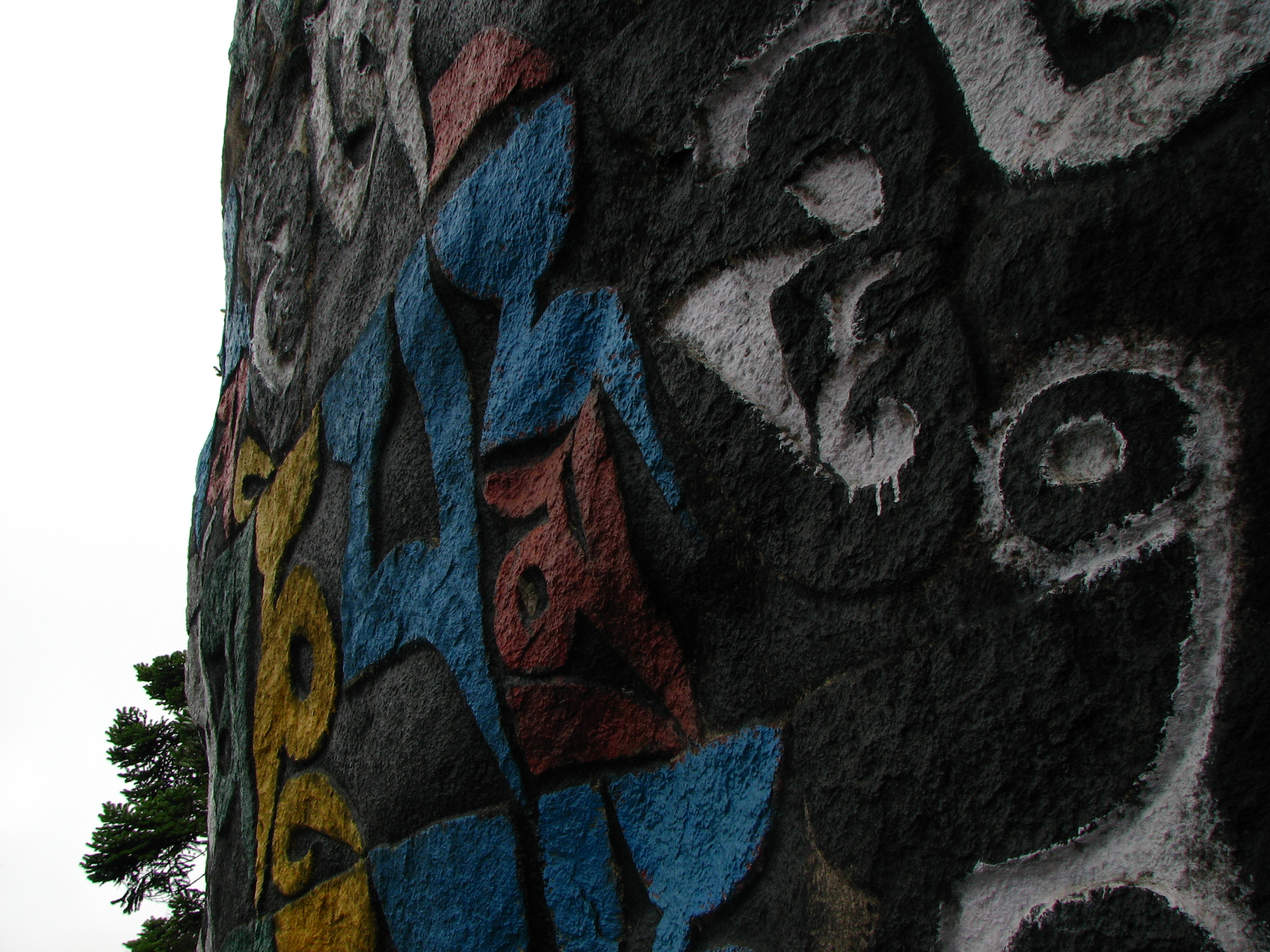
Understanding the name behind the Mani Rimdu Festival unlocks something the public dances alone don't fully explain, and it's worth pairing that meaning with a bit of Mani Rimdu Festival history. "Mani" refers to the mantra of Chenrezig, the bodhisattva of compassion, whose six-syllable prayer, Om Mani Padme Hum, echoes throughout Tibetan Buddhist practice and gives the festival its first half. "Rimdu" traces back to "Rilbu," naming the small, blessed red pills distributed to attendees during the closing ceremonies, a tangible piece of the festival's accumulated merit, carried home in a pocket rather than only in memory.
Together, the name captures something the masked dances alone can't fully convey: compassion given physical form, blessing made portable. Receiving a Rilbu pill at the festival's close isn't a souvenir in the ordinary sense. Within Sherpa Buddhist tradition, it's understood as carrying genuine spiritual protection, prepared and blessed by lamas over the course of the festival's private rituals, meant to accompany the recipient well beyond the monastery courtyard.
The naming reflects a broader pattern worth noticing throughout Mani Rimdu: very little happens without layered meaning. Every dance, every color, every object placed on the altar carries significance built from centuries of Buddhist practice, refined and passed down through generations of Sherpa monks and teachers. Approaching the festival with even a basic understanding of what its name actually means transforms the experience from spectacle into something closer to its intended purpose, a living transmission of compassion, protection, and hard-won wisdom, offered openly to anyone present to receive it.
The Nineteen Day Cycle: From Private Ritual to Public Celebration
Most visitors only ever witness the final three days of Mani Rimdu. Still, the full cycle stretches across nineteen days, following the Tibetan lunar calendar rather than a fixed Gregorian date. Mani Rimdu Festival dates shift each year accordingly, sometimes landing in late October and other years pushing into November, and confirming the exact public days for any given year matters considerably for anyone planning a trip around them. Understanding the whole arc, not just the public celebration, changes how those three visible days actually land.
The cycle opens with nearly two weeks of private preparation, closed entirely to outside visitors. Monks engage in deity yoga and sustained meditation, making offerings to protector deities and beginning the meticulous construction of the sand mandala grain by grain. This isn't preamble to the "real" festival; it's the foundation the public celebration rests on, monks spending days embodying the deities they'll later portray in dance, building the spiritual groundwork long before donning a single mask.
Three days of public celebration follow, opening the monastery courtyard to Sherpa families, pilgrims, and travelers alike. The first day centers on prayer and ritual offering, including Ser Kyem, a ceremonial tea offering made to the Dharma's guardian deities. The second day brings the festival's visual centerpiece, the masked Cham dances, performed in sequence throughout the courtyard as monks embody specific deities through movement, costume, and mask. The third and final public day includes Wang, the mass blessing ceremony, where lamas offer spiritual empowerment directly to attendees, alongside the ceremonial dismantling of the sand mandala completed days earlier.
Two closing days round out the full cycle, private rites conducted by monks alone, formally concluding the ritual sequence and returning the monastery to its ordinary daily rhythm. What looks, from the outside, like three dramatic days of dance and color is really the visible tip of a much longer, carefully structured spiritual undertaking, one where every public gesture rests on nearly two weeks of unseen devotion.
The Sand Mandala: Built to Be Destroyed
Long before the first mask appears in the courtyard, Mani Rimdu at Tengboche begins with monks kneeling over a flat platform, working colored sand into place grain by grain, building what will become one of the festival's most striking and least understood elements. The sand mandala takes shape over roughly ten days of private construction, a meditative practice as much as an artistic one, each monk channeling sustained focus into a pattern that will exist, in its finished form, for only a matter of hours.
The mandala itself represents a deity's sacred dwelling, an intricate, symmetrical map of a spiritual realm rendered in impossibly fine detail using nothing but colored sand and steady hands. Lamas meditate before it throughout its construction, treating the growing pattern not as decoration but as an active spiritual practice, drawing the mind toward the deity the mandala represents long before any public ceremony begins.
What happens once the mandala reaches completion carries the festival's deepest teaching. Rather than preserving the finished work, monks ceremonially dismantle it during the festival's third public day, sweeping away in minutes what took days of painstaking devotion to build. The destruction isn't careless or symbolic in some abstract sense; it's the entire point made visible. Buddhist teaching holds impermanence as a central truth: nothing, however beautiful or hard-won, lasts forever, and the mandala's swift undoing embodies that lesson more directly than any sermon could.
Sand from the dismantled mandala doesn't simply disappear, either. Traditionally, it's gathered and offered to a nearby river, carrying the mandala's accumulated blessing outward into the wider world, a final act that turns destruction into continuation rather than loss. Watching a mandala built over ten days disappear in minutes tends to stay with visitors long after the festival ends, a quiet, visual argument for letting go that few other traditions state so plainly.
Inside the Masked Dances: Who the Deities Are and What They Represent
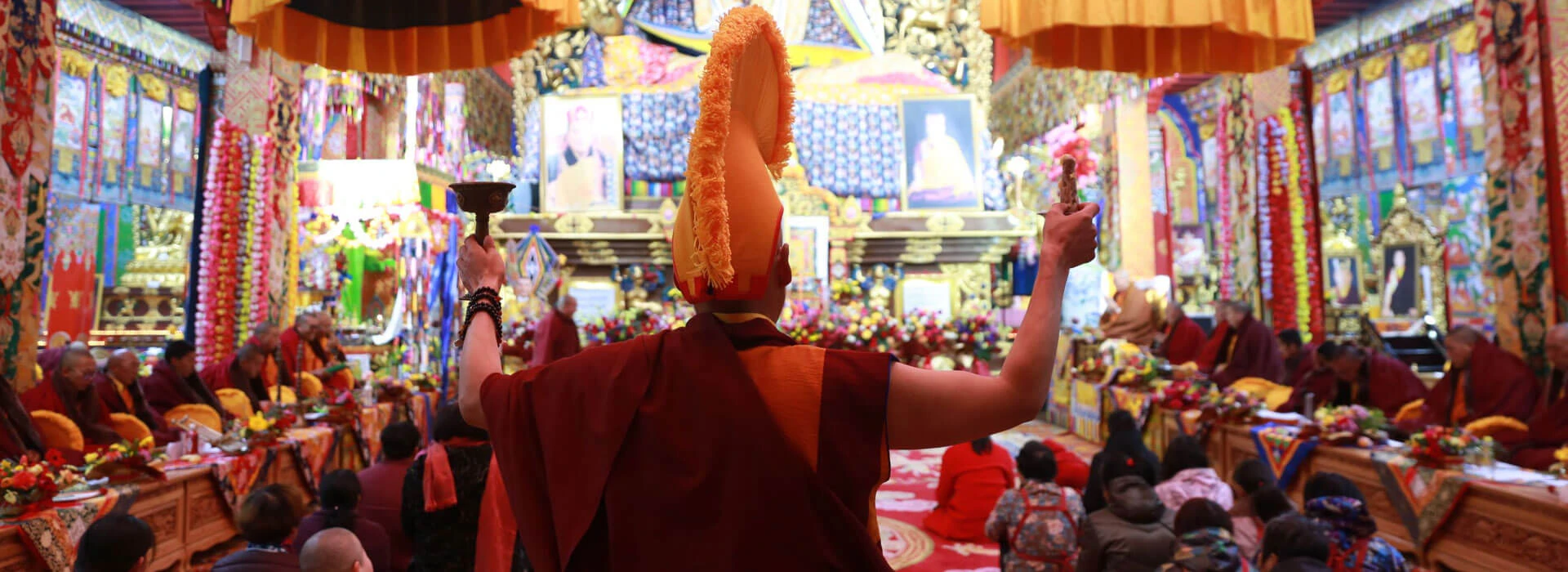
Every Mani Rimdu Cham dance carries specific meaning, no gesture arbitrary, no costume chosen for spectacle alone. Monks spend the festival's private days meditating themselves into these roles, so what appears in the courtyard isn't quite performance in the ordinary sense; it's closer to embodiment, a deity made temporarily visible through disciplined ritual practice.
The Dance of the Black Hat Sorcerer (Shanak)
Dancers wearing broad, sweeping black hats move through the courtyard in slow, deliberate sweeps, ritually cleansing the space of malevolent spirits before the festival's central ceremonies continue. Shanak represents the active subjugation of negative forces, not through violence but through disciplined ritual authority, clearing the ground, both literally and spiritually, for what follows.
The Dance of the Protectors (Mahakala and Mahakali)
Fierce, multi-colored masks mark this dance's Dharma Protector deities, their expressions deliberately frightening, wrathful in appearance rather than in intent. Within Tibetan Buddhist tradition, this ferocity exists in service of compassion, destroying ignorance and delusion rather than causing harm, guardian figures whose intensity protects the faith rather than threatens it.
The Dance of the Four Protecting Deities
Paper masks in distinct colors, each bearing an unshifting smile, identify the four guardians defending Buddhist teaching against demonic attack. Cymbals mark the rhythm of their hopping, energetic movement, and the dancers playfully charge toward children watching from the crowd, a moment of genuine levity built into an otherwise solemn ceremony, proof that reverence and joy aren't mutually exclusive within this tradition.
The Dakini Dance
Five young priests perform this dance without masks, moving in slow, precise steps timed to soft bells and drums. Representing female spiritual figures, consorts of Padmasambhava himself, the Dakini dance splits symbolic roles between genders: males, elsewhere in the festival shown masked, represent skillful means and strategy, while the unmasked female figures represent wisdom itself. Its slower, gentler rhythm offers real contrast against the festival's more forceful dances, a different register of the same underlying teaching.
Together, these dances build toward the same central message repeated throughout Mani Rimdu: wisdom overcoming ignorance, compassion overcoming harm, protection extended not through force but through disciplined spiritual practice. Watching them in sequence, rather than as isolated spectacle, reveals a coherent narrative unfolding across the Tengboche courtyard, one Sherpa communities have carried forward, unchanged in essence, for generations.
Tormas and Fire: The Offerings Behind the Ceremony
Beyond the masks and choreographed movement, two quieter elements sit at the heart of Mani Rimdu rituals, easy to overlook amid the color of the dances but central to what the ceremony actually accomplishes.
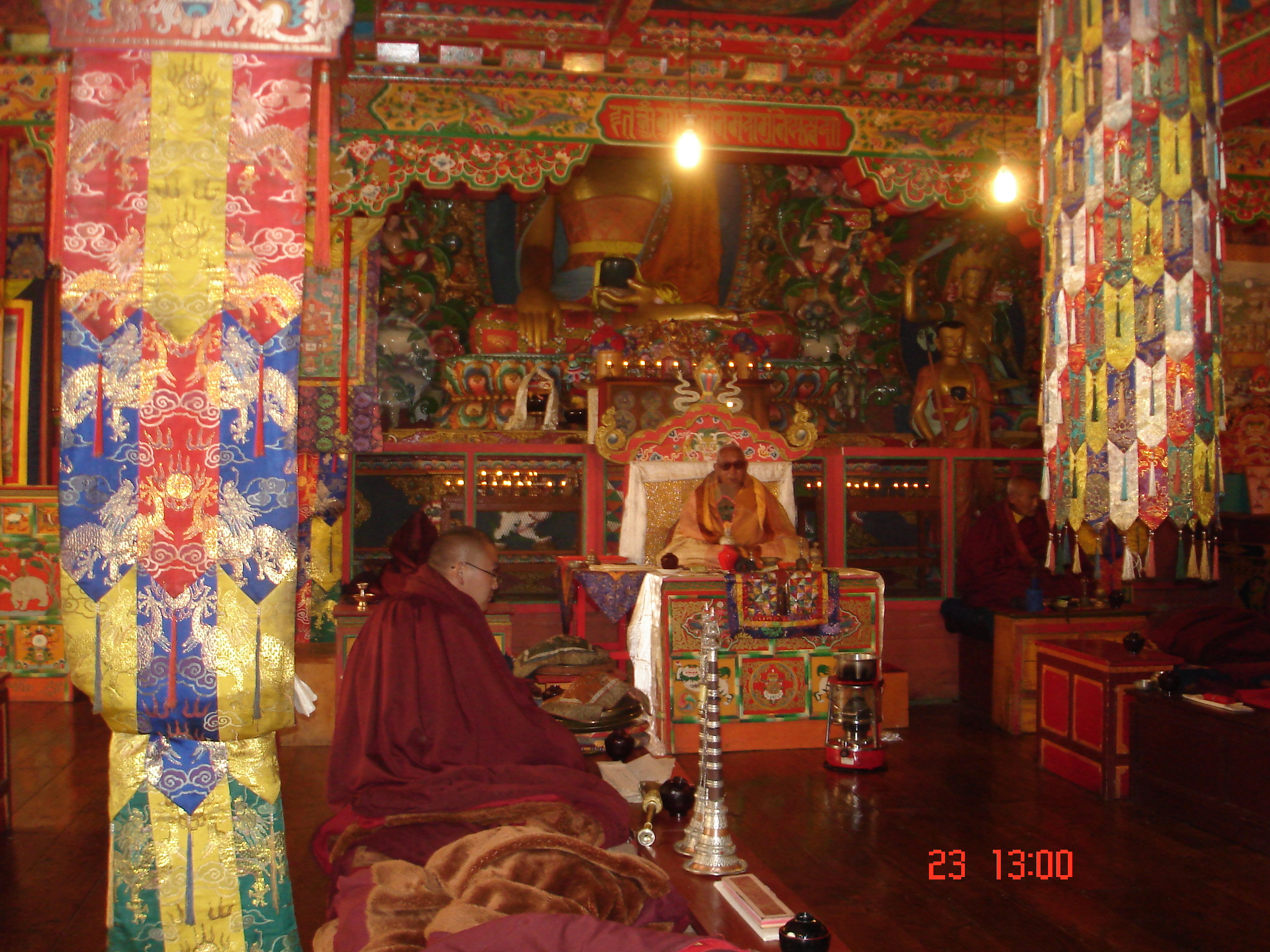
The torma stands at the very center of the ritual display, a striking piece crafted from barley flour and decorated with colored butter, placed directly facing the sand mandala on its own dedicated shrine. Its meaning shifts across the course of the festival. At first, it represents the physical body of the deity, a vessel holding sacred presence. By the ceremony's end, that same object comes to represent enlightenment itself, a visible transformation from form into realization, standing at the literal center of the temple as a constant reminder of what the entire festival works toward.
Fire carries its own weight in the ritual sequence, arriving through Jinsak, the fire puja performed the day after the masked dances conclude. Monks make offerings to Agni, the god of fire, and to the protector deities of the mandala, seeking to ease suffering across the world through a deliberately symbolic act. Grain and clarified butter are burned together, visualized as harm and negativity dissolving into flame, a physical enactment of release rather than mere ritual gesture. Once the fire offering concludes, the sand mandala itself, built with such care days earlier, is finally taken apart, its sand offered afterward to the Nagas, serpent deities associated with water and the unseen world beneath it.
Together, the torma's quiet transformation and the fire's deliberate consumption round out a theme running through nearly every element of Mani Rimdu: nothing sacred here exists to be preserved permanently. Objects built with extraordinary care exist specifically to be released, burned, or dismantled, a repeated lesson in letting go that the festival teaches through action rather than instruction, offered each year again to anyone present enough to notice it.
Why Mani Rimdu Matters to the Sherpa Community
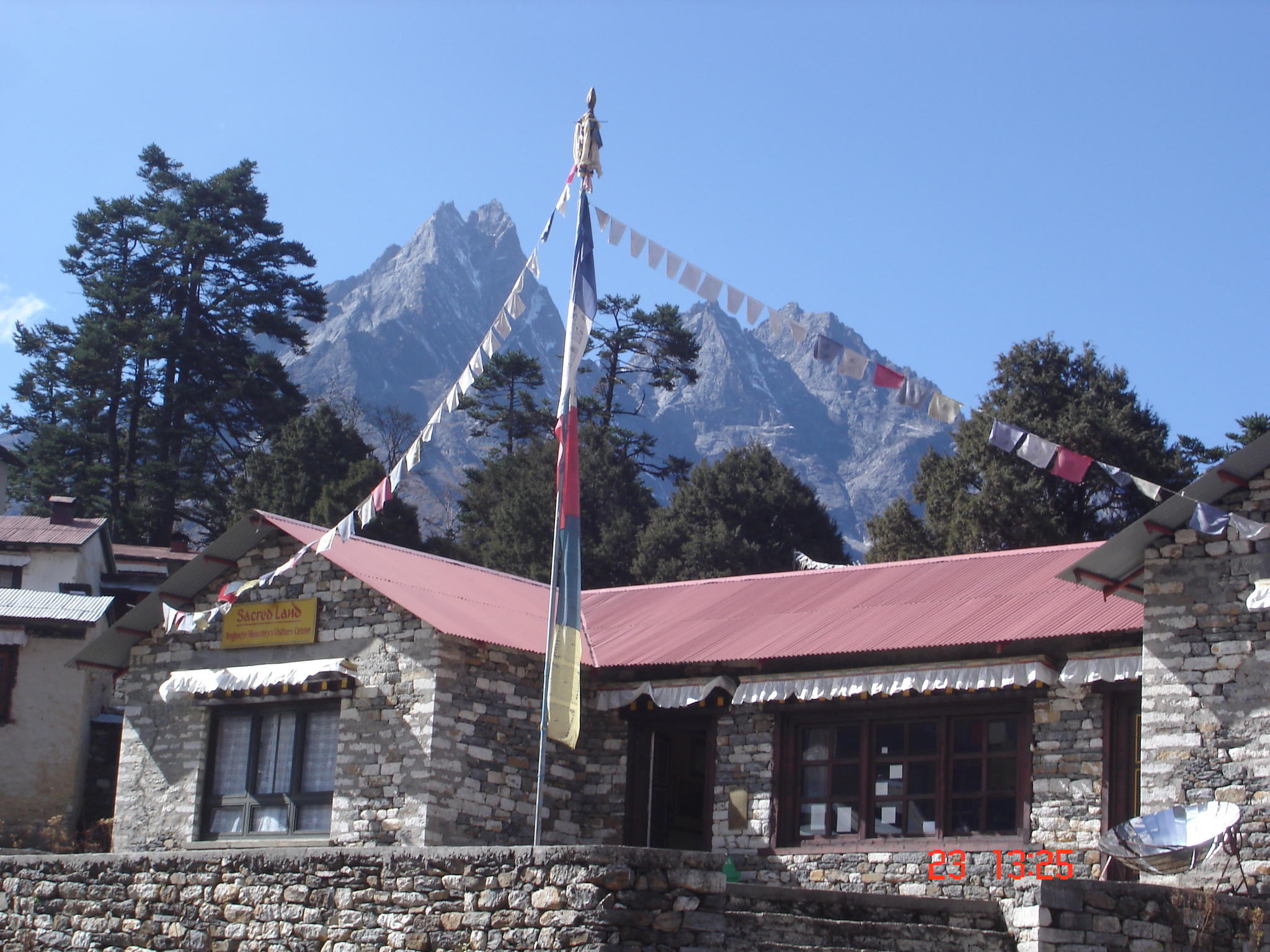
Strip away the masks, the mandala, and the fire ritual, and the Tengboche Mani Rimdu celebration still carries weight far beyond spectacle for the people of the Khumbu. For Sherpa communities across Tengboche, Thame, and Chiwong, this Sherpa festival in Nepal stands as the single biggest religious event of the year, a moment when spiritual devotion, cultural memory, and community gathering all converge in one place.
Buddhism shapes daily life across the region in ways visitors often only glimpse briefly: prayer flags fluttering over trekking trails, mani walls lining village paths, monasteries anchoring nearly every settlement. Mani Rimdu gathers that everyday devotion into something concentrated and shared, an annual reaffirmation of belief practiced collectively rather than privately. Watching monks embody deities through dance, families offer prayers together in the courtyard, and elders pass tradition to children simply by bringing them along reveals a community actively maintaining its own spiritual continuity, not performing it for outside observers.
Children raised in Sherpa villages grow up attending the Mani Rimdu Festival in Khumbu the way children elsewhere might grow up attending a family holiday gathering, present long before they fully understand the ritual's deeper meaning, absorbing its rhythm and significance gradually across repeated years. That slow, generational transmission matters enormously in a region where Buddhist practice and Sherpa cultural identity remain deeply intertwined, each festival reinforcing the other, ensuring neither fades even as modern life reaches further into the Khumbu each year.
Compassion, wisdom, and protection from harm, the values embedded in every dance and ritual object, extend well beyond the monastery courtyard once the festival concludes. Community bonds strengthen through shared celebration, elders find renewed purpose passing tradition forward, and younger generations gain a concrete, lived connection to beliefs that might otherwise feel abstract or distant. Mani Rimdu, in that sense, functions as something closer to cultural infrastructure than religious spectacle, a yearly ritual holding Sherpa identity together across generations, in a landscape where preserving that continuity takes real, deliberate effort.
Color, Cymbal, and Flame: What Mani Rimdu Feels Like
Everything explained so far- the etymology, the ritual sequence, the meaning behind each dance- sets up the intellectual understanding of the Mani Rimdu Festival celebration. None of it quite prepares a visitor for what the courtyard actually feels like once it begins.
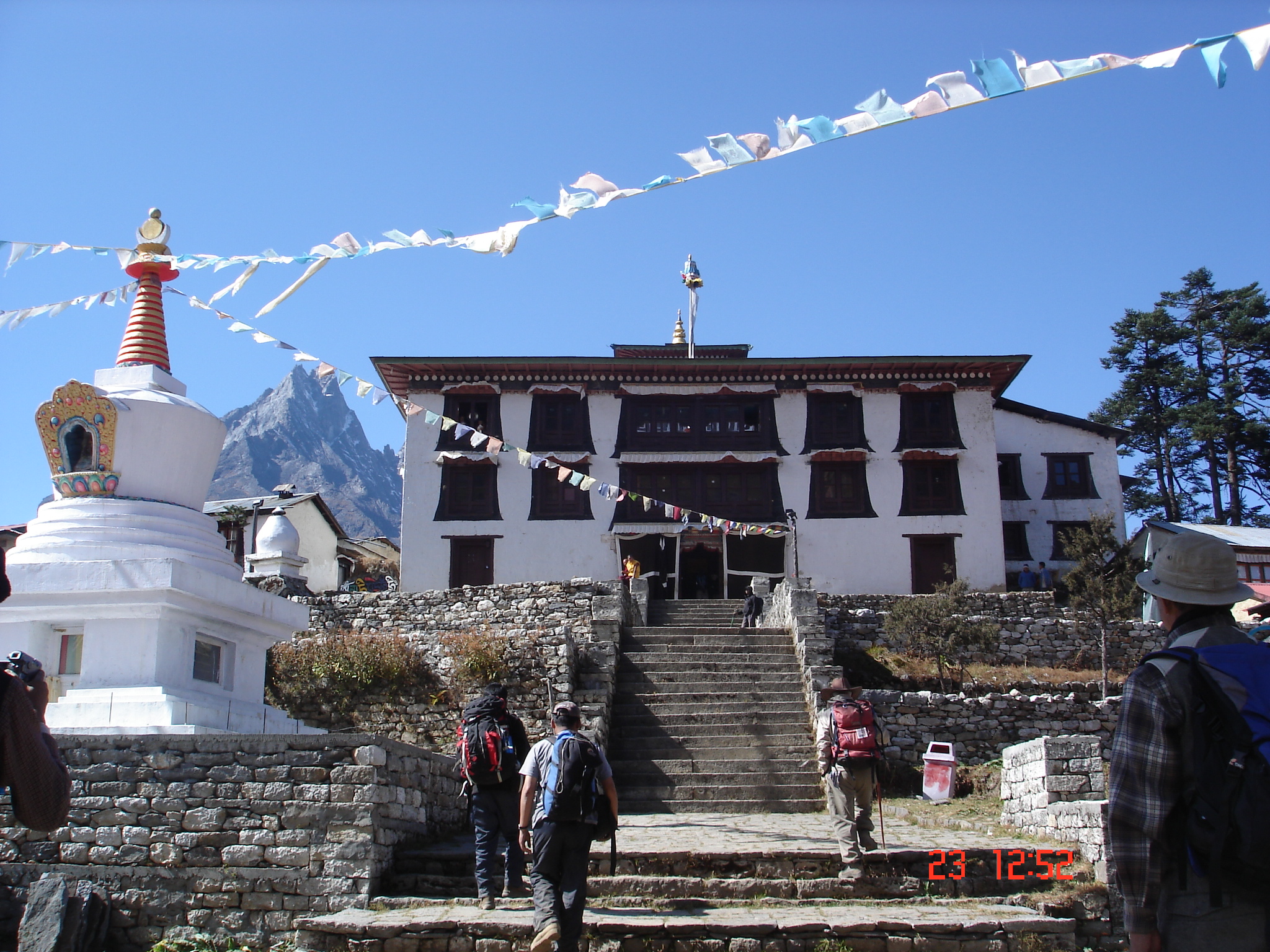
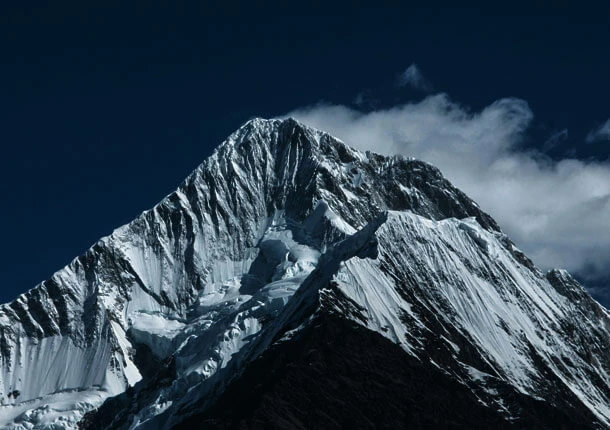
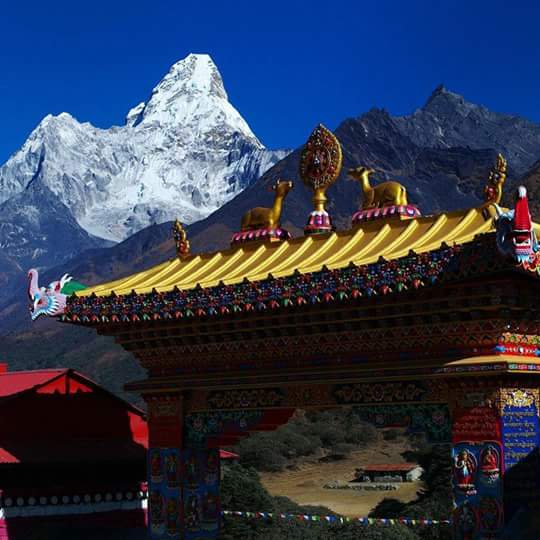
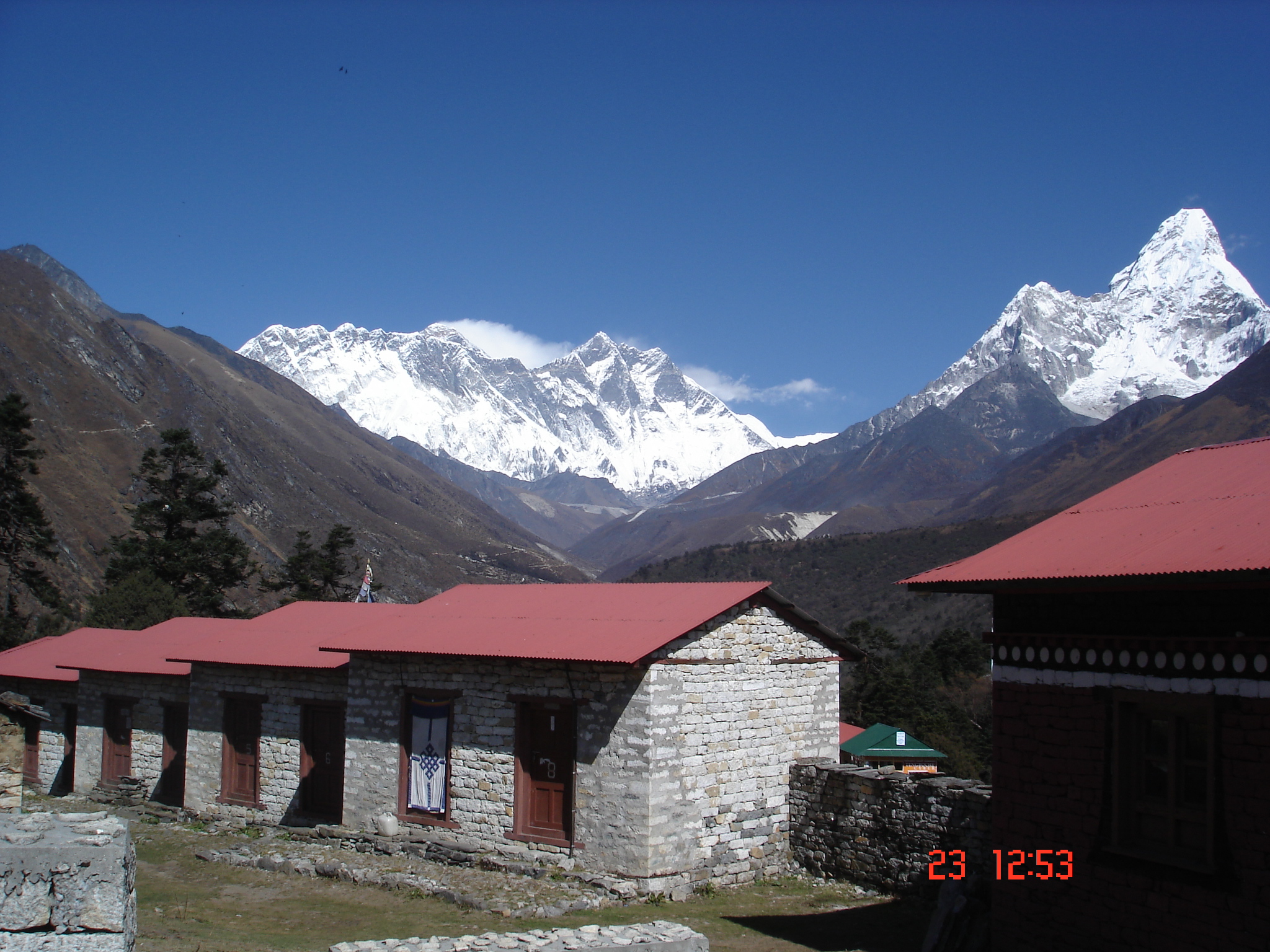
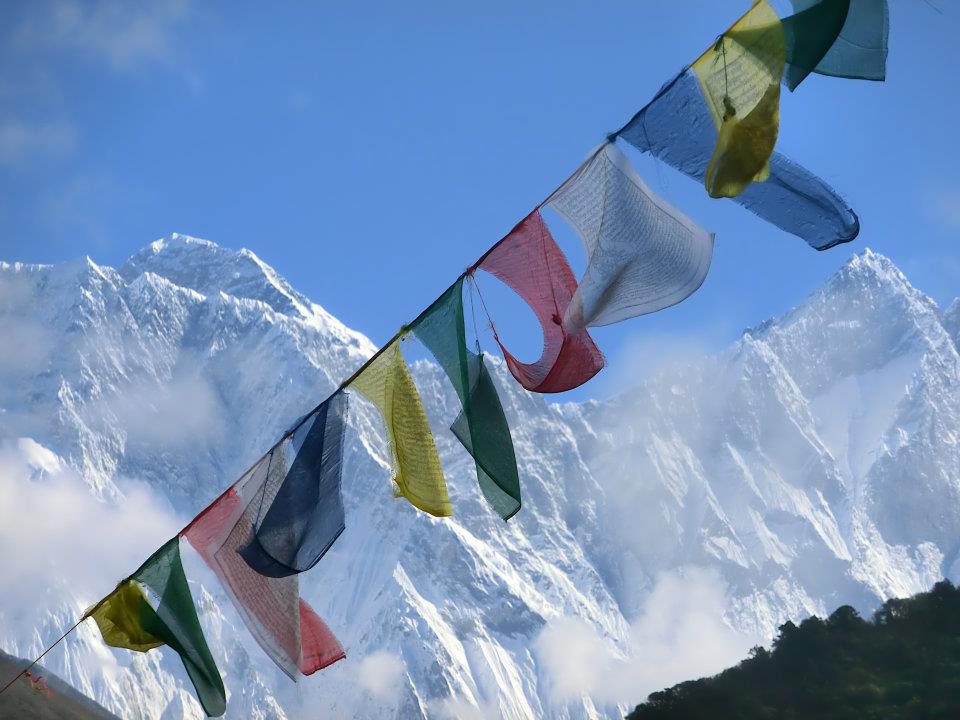
The visual shock arrives first. Tengboche's usual backdrop, grey granite, white snow, brown earth, gets shattered by an explosion of color: prayer flags, sand mandala, and monastic robes all drawing from the same five sacred hues: blue, white, red, green, and yellow, each representing a specific element and quality within Tibetan Buddhist symbolism. Ama Dablam rises directly behind the monastery throughout, a silent, towering witness to a display of color that feels almost impossibly vivid against such stark, high-altitude surroundings.
Costume carries its own weight beyond mere visual impact. Heavy, hand-painted wooden masks transform each dancer into deity, demon, or legendary figure, and within Sherpa belief, the transformation runs deeper than symbolism; monks genuinely become the spirits they portray for the duration of the dance. Brocade silk robes swirl dramatically with every spin, catching whatever light the high-altitude sun offers, while ritual daggers known as phurba and silver ornamental pieces flash and glint with each deliberate movement.
Sound builds its own presence alongside sight. Dungchen, the long copper horns synonymous with Himalayan monasteries, produce a deep, resonant roar closer to a vibration than a melody, something felt in the chest as much as heard. Cymbals crash in sharp counterpoint, while steady, trance-inducing drumbeats dictate the dancers' every step. Beneath it all runs a constant low hum, monks chanting continuously, a soundscape that never fully quiets throughout the ceremony.
The dances themselves function as something close to sacred opera, narrating Buddhism's historic triumph over older, darker spiritual forces across the Himalayan region. Even within such solemnity, genuine humor finds room to breathe; the Black Hat dancers share the stage with playful, comic characters who interact directly with the crowd, a reminder that devotion and celebration were never meant to stand apart. That underlying victory finds its clearest expression later, when the painstakingly built sand mandala is finally swept away, a deliberate, symbolic cleansing that clears space for whatever the community's year ahead may bring.
As daylight fades and temperatures drop sharply, the courtyard transforms once more. Hundreds of butter lamps flicker to life, their warm orange glow pushing back against the mountain cold, while the mingled scent of burning yak butter and juniper incense settles over everything. Overhead, stars emerge with startling clarity, Tengboche's altitude bringing them close enough to feel almost within reach. Firelight below, brilliant cold light above, the entire scene starts to feel less like a festival held for a single community and more like a ritual offered outward, toward the whole quiet universe surrounding it.
Witnessing Mani Rimdu: What Stays With You
Understanding Mani Rimdu Festival in full, the etymology behind its name, the nineteen-day cycle building toward three public days, the sand mandala built only to be destroyed, each masked dance carrying centuries of meaning, changes what it actually feels like to stand in that courtyard. Knowledge doesn't diminish the wonder of watching monks become deities through disciplined ritual. It deepens it.
What lingers longest after leaving Tengboche rarely turns out to be the spectacle alone. It's the quieter recognitions built along the way, understanding that a torma sitting at the center of the ceremony transforms in meaning as the ritual unfolds, watching a mandala swept away in minutes after ten days of painstaking construction, hearing dungchen horns roar like the mountain itself finding its voice. Butter lamps flickering against a cold, star-filled sky above Ama Dablam tend to stay vivid in memory long after the details of any single dance have blurred together.
More than anything, Mani Rimdu offers a genuinely rare kind of access, a living tradition, still practiced exactly as generations before have practiced it, still carrying real meaning for the Sherpa community rather than performed for outside eyes. Visitors fortunate enough to witness it step, briefly, into something far older and more enduring than a single festival season, a continuous thread of compassion, wisdom, and protection passed from teacher to student, from parent to child, across centuries in one of the world's most demanding landscapes.
Whether that understanding comes before setting foot in the Khumbu or unfolds gradually while standing in the courtyard itself, what remains true either way is this: Mani Rimdu was never created for spectators. It exists because a community has chosen, year after year, to keep it alive. Anyone present to witness it carries home something considerably more lasting than photographs, a genuine glimpse into how devotion, memory, and identity get carried forward, one carefully built mandala at a time.